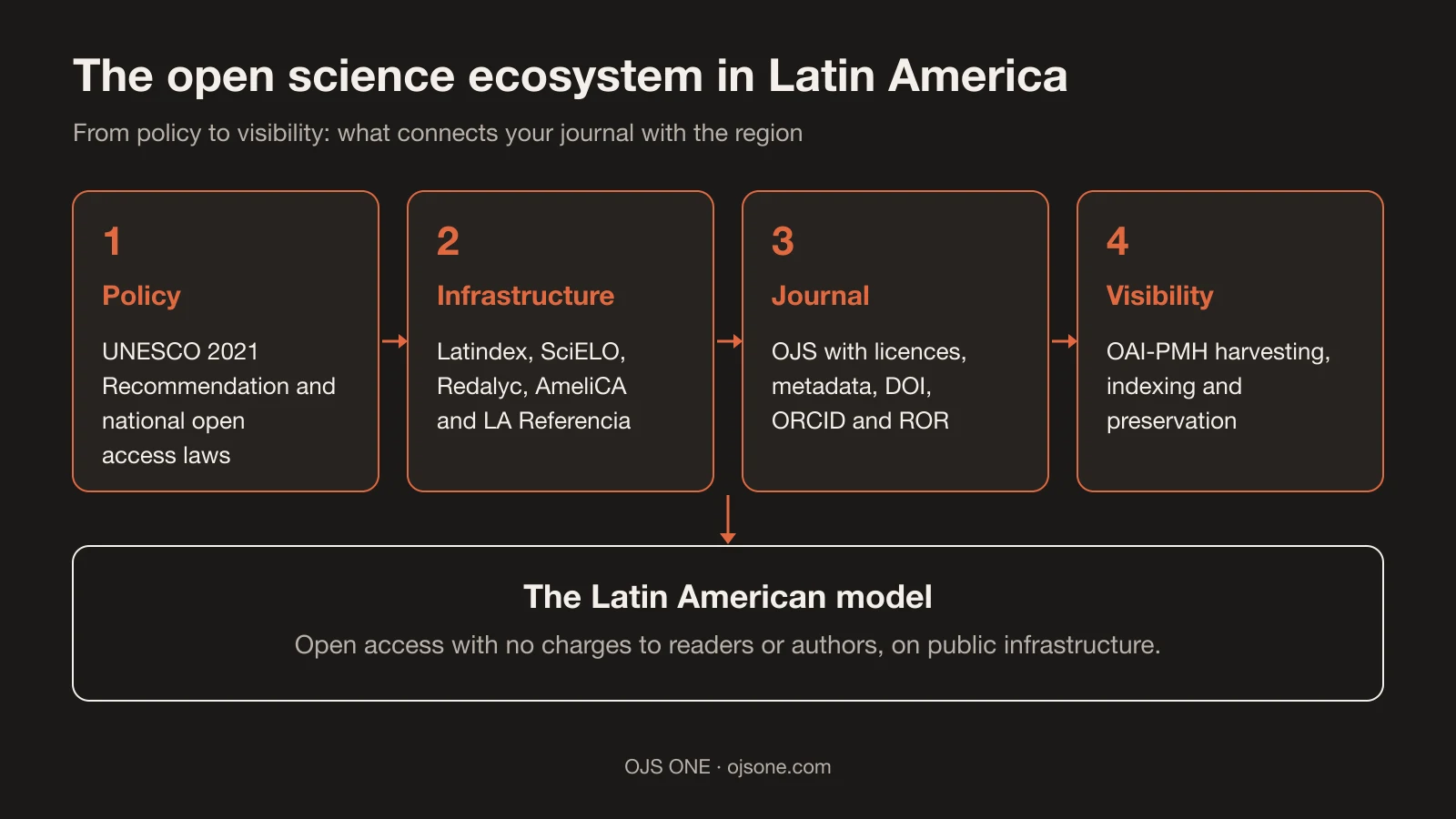
Open science in Latin America has a feature that sets it apart from the rest of the world: it was built on public, non-profit infrastructure (SciELO, Redalyc, Latindex, LA Referencia) and on journals that, for the most part, charge neither readers nor authors. Today that model has international backing, with UNESCO's 2021 Recommendation, and national laws or policies in several countries. For a journal or a university, this translates into concrete requirements: visible policies, interoperable metadata, persistent identifiers, deposit in repositories and preservation.
This guide maps the regional landscape, summarizes what each country requires and turns it all into tasks your OJS journal can carry out. At the end you will find the detailed guides on each topic.
What open science is and why it matters now
Direct answer: it is the practice of making research results, data and processes accessible, reusable and verifiable, and since 2021 it has a shared international framework.
UNESCO's General Conference adopted the Recommendation on Open Science in November 2021, the first international framework on the subject, agreed by its 193 member states.1 The Recommendation is not limited to open access to publications: it covers data, software, open infrastructures and the participation of society, and it favours non-profit publishing models.1
For Latin America this carries particular weight, because the region was already practising much of that model before the framework existed. In 2018, universities and civil society organizations in the region promoted the Panama Declaration on Open Science, which calls on governments to adopt national policies suited to the problems of Latin America and the Caribbean, with a focus on open access and evaluation indicators.2
The Latin American model: no-fee open access on public infrastructure
Direct answer: diamond open access (no charges to readers or authors) predominates in the region, sustained by universities and by non-profit regional infrastructures.
Unlike the commercial model that charges article processing charges (APCs) to publish openly, most Latin American academic journals are published by universities and do not charge. That ecosystem rests on pieces worth knowing by name:
| Infrastructure | What it is | What it asks of your journal |
|---|---|---|
| Latindex | Regional information system on scientific journals, born at UNAM in 1995, with a Catalogue of editorial quality.3 | Meeting the Catalogue 2.0 characteristics, verifiable on the journal's website. |
| SciELO | Network of national collections of peer-reviewed journals, started in Brazil in 1998 with support from FAPESP and BIREME.4 | XML compliant with the SciELO Publishing Schema (SPS) and the collection's editorial criteria. |
| Redalyc and AmeliCA | Non-profit infrastructure for diamond open access: Redalyc for consolidated journals and AmeliCA for journals in consolidation.5 | A no-APC model, peer review and production in structured formats. |
| LA Referencia | Federated network of repositories: each country runs a national node that harvests its institutional repositories.6 | Metadata following the network's guidelines and working OAI-PMH harvesting. |
| DOAJ | Global directory of open access journals, widely used in the region. | Visible policies, clear licences and up-to-date article metadata. |
The practical conclusion: in Latin America a journal's visibility does not depend on paying to be on a commercial platform, but on properly meeting the technical and editorial requirements of this open infrastructure.
What each country requires: open access laws and policies
Direct answer: several countries already have legal obligations to deposit publicly funded research in repositories; others have national policies or are in the process of creating them.
| Country | Law or policy | What it establishes |
|---|---|---|
| Argentina | Law 26.899 (2013), regulated in 2016. | State-funded institutions must create open access institutional repositories, and researchers must deposit their publicly funded output within six months of publication.7 |
| Peru | Law 30035 (2013) and its 2015 regulation. | Creates the National Digital Open Access Repository for Science, Technology and Innovation (ALICIA), which integrates the output of the country's institutional repositories.8 |
| Mexico | Amendment to the Science and Technology Law published on 20 May 2014. | Adds a chapter on open access and creates the National Open Access Repository of Scientific, Technological and Innovation Information Resources.9 |
| Chile | ANID Open Access Policy, in force since 2022. | Requires publications, theses and research data funded by ANID to be made openly available through deposit in a repository.10 |
| Colombia | National Open Science Policy 2022-2031 (Minciencias Resolution 0777 of 2022). | A national policy based on the UNESCO Recommendation, with components on open scientific knowledge, infrastructure, social appropriation and open communication.11 |
| Brazil | National open science policy being drafted, coordinated by the Ministry of Science, Technology and Innovation (MCTI). | Brazil's open government commitment includes bringing open science into the national STI strategy; drafting of the policy is ongoing.12 |
Two useful readings of this table. First, the trend is clear: publicly funded research must end up in open access and deposited in interoperable repositories. Second, compliance is verified through metadata: if your journal or repository does not expose its records properly, your authors' output does not appear in the national nodes or in LA Referencia.
In Chile, the national node Espacio Ciencia also integrates the repositories that follow shared metadata guidelines; we explain it in institutional repositories in Latin America.
What open science means for an OJS journal
Direct answer: OJS already includes almost all the tools; what is usually missing is configuring them well, declaring them on the website and maintaining them.
This is the list we use to check whether a journal is aligned with open science in the region:
- A declared open licence on every article and in the journal's policy (for example, a Creative Commons licence), consistent with what the PDF and the metadata say.
- Visible policies: open access, no charges or declared charges, peer review, ethics, preservation and copyright. What is not visible on the website cannot be assessed.
- Complete, harvestable metadata: OAI-PMH active and responding, with authorship, affiliation, abstract, keywords and licence per article. It is what Latindex checks in its interoperability feature and what OpenAlex uses to harvest your journal.
- Persistent identifiers: a DOI for every article, ORCID for authors and ROR for affiliations. Check your deposits with Crossref Manager in OJS 3.5 and affiliations with ROR in Crossref.
- Structured formats: for SciELO and Redalyc, validated JATS XML in addition to the PDF; HTML readable on the page improves reading and reuse. We cover it in validating JATS XML.
- Digital preservation: a real mechanism (not just a declared one) so the journal outlives its server. See digital preservation in OJS.
- Post-publication integrity: a corrections and retractions policy, ideally made visible with Crossmark.
- Transparent review: deciding whether and how to open peer review, now that OJS 3.6 will allow it. See open peer review in OJS 3.6.
What it means for a university
Direct answer: complying with your country's law or policy requires running two connected pieces, the journal portal and the institutional repository, with the same metadata discipline.
- Institutional repository with a written deposit policy, standard metadata, persistent identifiers and integration into the national node.
- OJS journal portal that is up to date, secure and meets every requirement on the list above for each title.
- Shared governance: named owners, a review calendar and evidence of compliance, because funding agencies and indexes verify what is published, not what was planned.
If your portal still runs an old OJS version, that is the first bottleneck: OJS 3.3 and 3.4 reach end of support in the second quarter of 2027, as we explain in OJS 3.3 end of support.
A four-stage route to align your journal with open science
- Diagnosis: review the eight requirements above and mark which ones you meet with evidence. The University of Chile applied a diagnosis model like this to 67 journals from state universities; we summarize it in indexing routes in Chile.
- Declarative base: publish complete policies, licences and editorial board. It is the cheapest thing to fix and the first thing an evaluator looks at.
- Technical base: metadata, OAI-PMH, DOI, ORCID, ROR, JATS XML and preservation working and verified.
- Application and maintenance: choose the route (DOAJ, Latindex, SciELO, Redalyc) according to your real state. If you are aiming at DOAJ, see applying to DOAJ without intermediaries and article metadata in DOAJ.
Common mistakes
- Believing that "being open access" is enough: without harvestable metadata or declared licences, the journal is open but invisible.
- Declaring on the website a policy the journal does not follow: indexes check consistency between what is said and what is done.
- Treating the repository and the journal portal as separate projects, with different metadata for the same articles.
- Postponing the OJS upgrade: an unsupported version compromises the security and continuity of everything above.
- Paying intermediaries to "manage" an indexing application the journal itself can prepare and submit.
How OJS ONE helps
OJS ONE works only with OJS and with academic journals in the region. To align your journal or portal with open science:
- OJS 360 Assessment: a diagnosis of your journal against the requirements of DOAJ, Latindex and SciELO, with a prioritized route and owners.
- Managed OJS operation: an up-to-date, secure portal with OAI-PMH, DOI and editorial email working, and tested backups.
- Jatson: production of PDF, HTML and validated JATS XML for SciELO and Redalyc from the accepted article.
- Cybersecurity for OJS: audit, patches and incident response, so that openness does not turn into exposure.
The decision to index always belongs to each index; what we can make sure of is that your journal arrives with everything verifiable in order. Request the diagnosis or write to us.
Frequently asked questions
What is diamond open access?
It is the model in which the journal charges neither readers to read nor authors to publish; costs are covered by the publishing institution or the community. It is the predominant model among Latin American university journals and the one promoted by infrastructures such as Redalyc and AmeliCA.5
Does my country's law require anything of my journal?
The laws of Argentina and Peru, Mexico's amendment and ANID's policy in Chile are aimed mainly at institutions and publicly funded research: they require deposit in open access repositories.78910 For a journal, the practical consequence is to expose its metadata and licences properly so that those deposits and national harvesting work.
Is OJS suitable for open science compliance?
Yes. OJS is free software and includes OAI-PMH, DOI, ORCID and metadata export; what makes the difference is configuration, version and maintenance. An old or poorly configured installation complies on paper and fails at harvesting.
Where do I start if my journal meets almost nothing?
With the diagnosis and the declarative base: visible policies, licences and editorial board. Then the technical base. Applying before having both only adds a rejection to the journal's record.
Sources
- UNESCO. UNESCO Recommendation on Open Science (2021). https://www.unesco.org/es/open-science/about (accessed 19 November 2026).
- Fundación Karisma et al. Declaración de Panamá sobre Ciencia Abierta (2018). https://web.karisma.org.co/wp-content/uploads/download-manager-files/declaracion_panama_ciencia_abierta.pdf (accessed 19 November 2026).
- Latindex. Regional Online Information System for Scientific Journals of Latin America, the Caribbean, Spain and Portugal. https://www.latindex.org/latindex/ (accessed 19 November 2026).
- SciELO. About SciELO. https://scielo.org/es/sobre-el-scielo/ (accessed 19 November 2026).
- Redalyc and AmeliCA. https://www.redalyc.org/ and https://amelica.org/ (accessed 19 November 2026).
- LA Referencia. Federated Network of Institutional Repositories of Scientific Publications. https://www.lareferencia.info/ (accessed 19 November 2026).
- Argentine Republic. Law 26.899 on open access institutional digital repositories. https://www.argentina.gob.ar/normativa/nacional/223459/texto (accessed 19 November 2026).
- Diario Oficial El Peruano. Law No. 30035 regulating the National Digital Open Access Repository for Science, Technology and Innovation. https://busquedas.elperuano.pe/dispositivo/NL/946195-2 (accessed 19 November 2026).
- Diario Oficial de la Federación. Decree amending the Science and Technology Law, the General Education Law and the Organic Law of CONACYT, 20 May 2014. https://www.snieg.mx/Documentos/IIN/Acuerdo_3_XI_2015/Decreto_reforma_LGEducacionMayo20_2014.pdf (accessed 19 November 2026).
- Universidad de Chile. Open science: regulatory aspects (ANID Open Access Policy). https://uchile.cl/cienciaabierta/presentacion/aspectos-regulatorios (accessed 19 November 2026).
- Minciencias. Política Nacional de Ciencia Abierta 2022-2031. https://repositorio.minciencias.gov.co/entities/publication/893d2a48-d8d5-4c72-8159-e994f59b0158/full (accessed 19 November 2026).
- Controladoria-Geral da União. 6th Brazilian Open Government Action Plan, Commitment 3. https://www.gov.br/cgu/pt-br/governo-aberto/a-ogp/planos-de-acao/6deg-plano-de-acao-brasileiro/compromisso-3 (accessed 19 November 2026).
OJS 360 Assessment
Before applying, know exactly what is missing
We review metadata, DOIs, OAI-PMH, policies and preservation against what DOAJ, Latindex and SciELO ask for, and hand you a prioritized route with owners.
- Evidence-based diagnosis by dimension
- Prioritized route and correction plan
- Indexing decisions always belong to the index
OJS 360 Assessment
Before applying, know exactly what is missing
We review metadata, DOIs, OAI-PMH, policies and preservation against what DOAJ, Latindex and SciELO ask for, and hand you a prioritized route with owners.
Request a diagnosis