Cybersecurity and Editorial Continuity for OJS
We help protect the operational integrity and academic reputation of your publishing program. OJS-focused incident response, forensic investigation, and security architecture built for real editorial environments.
The cost of a compromised server is not technical. It is academic.
When an OJS installation is compromised, the consequences extend well beyond a temporary outage. In practice, incidents like SEO spam, hidden malware, or credential abuse tend to surface as:
Disruption across editorial workflows.
A loss of confidence among authors, reviewers, and editorial staff.
Exposure to metadata corruption, file integrity issues, and gaps in editorial traceability.
Browser or search-engine security warnings that undermine access and visibility.
In a scholarly publishing context, an incident does not affect only the server. It affects continuity, institutional trust, and the perceived reliability of the journal itself.
Specialized cybersecurity services for OJS
Our cybersecurity work is structured around three service lines, each designed for a different stage of risk within OJS environments.
Incident Response
We step in when a journal has been compromised, is distributing spam, shows signs of malware, is redirecting traffic, or has begun to lose access or trust signals. The response centers on containment, forensic investigation, and persistence removal so the environment can be stabilized safely.
Audit and Compromise Assessment
We assess whether an OJS installation may already be compromised, even when nothing looks obviously wrong. That includes reviewing indicators of compromise, suspicious access patterns, altered files, unsafe configuration, and lingering risk across the stack.
Hardening, WAF, and Secure Architecture
We reinforce editorial infrastructure with practical hardening, tighter permission models, webroot protection, monitoring, and WAF rules tuned to the way OJS actually behaves in production.
Threat Intelligence
Applied technical research on the real-world risks that affect OJS platforms and editorial continuity.
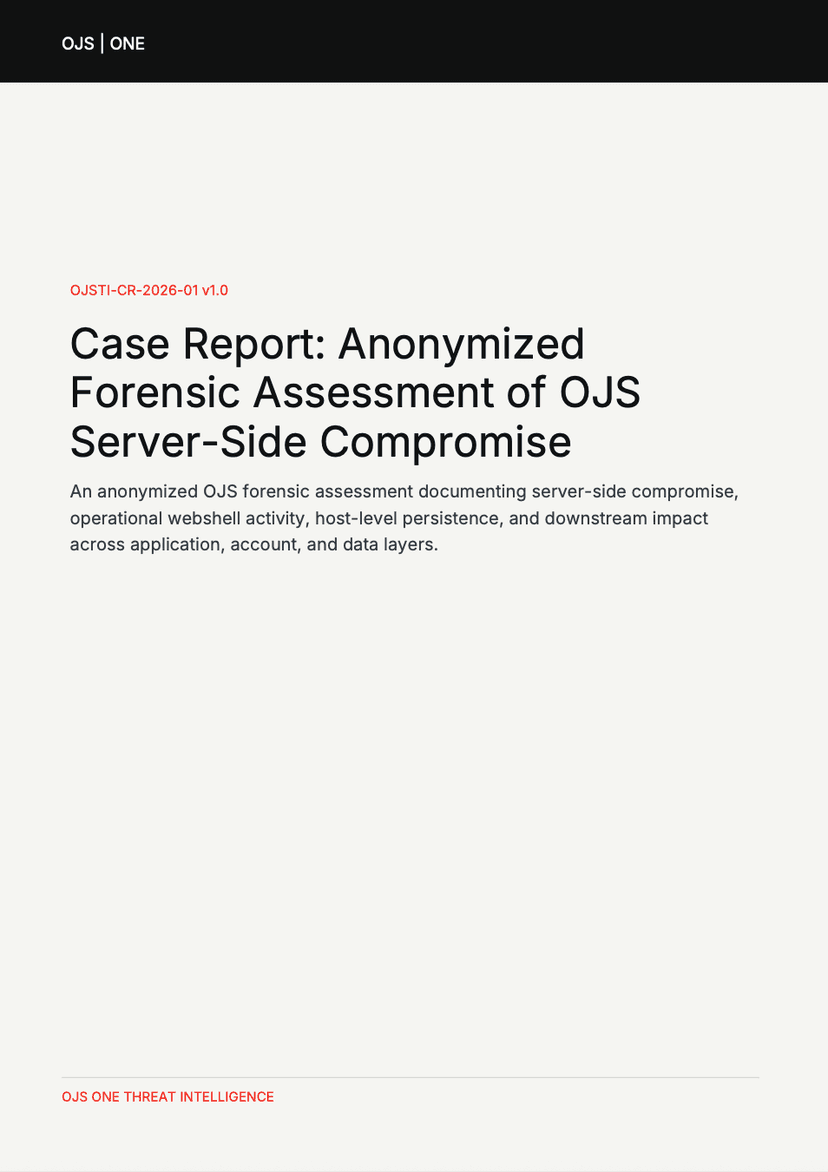
CASE STUDY (MASTER REPORT)
Server-Level Compromise and Persistence in OJS
A full forensic analysis of a real intrusion: from privilege escalation and abuse of legitimate plugins to persistent obfuscated webshells at the Linux operating-system level.
Download Official Case Report PDFANALYTIC SERIES: ATTACK DISSECTION
Declassification Radar - 9 Analytic Briefs
To understand the full anatomy of this incident, OJSTI is publishing a 9-part analytic series focused on each forensic layer. (Weekly updates).
Protect your publication workflow today.
Do not leave your editorial infrastructure exposed to security incidents, automated malware, or preventable disruption. Talk to an OJS specialist and strengthen journal operations with a serious technical strategy.
Fast contact form
Tell us what is happening and we will route your case to the right specialist.