Choosing where to apply without diagnosing your journal's real state is buying the ticket before knowing where you are going. A recent Chilean diagnosis confirms it: much of what indexes require does not depend on the quality of what you publish, but on how you declare it. This text sorts the indexing routes (DOAJ, Latindex, SciELO) according to your journal's starting point.
If you have already decided to apply to DOAJ, the guide applying to DOAJ without intermediaries covers the application; here we answer the question that comes before it.
Diagnose before choosing: the model that already worked in Chile
Direct answer: inventory, assess and classify; then decide the route.
The University of Chile ran a diagnosis and verification advisory for the journals of fourteen state universities between 2024 and 2026: it "started from an inventory of 190 publications, assessed 67 of them and produced more than 200 observations"1, classified by level of implementation so that each team knows what it meets and in which order to correct.
The finding, in the words of the person who coordinated it: the issues "have nothing to do with the quality of what they publish, but with the way they declare it"1. The journals were reviewed "in eight dimensions"1: identification and editorial transparency, teams and committees, scope and peer review, ethics, open access, preservation, authorship and open science, formats and identifiers1.
The practical consequence is harsh: "research stops being findable for anyone looking for it from another university or another country"1. That is the real cost of not diagnosing: you do not lose "indexing" in the abstract; you lose concrete readers. Here we answer the question that precedes any application: where do you start?
Indexing routes: how to prioritize according to your state
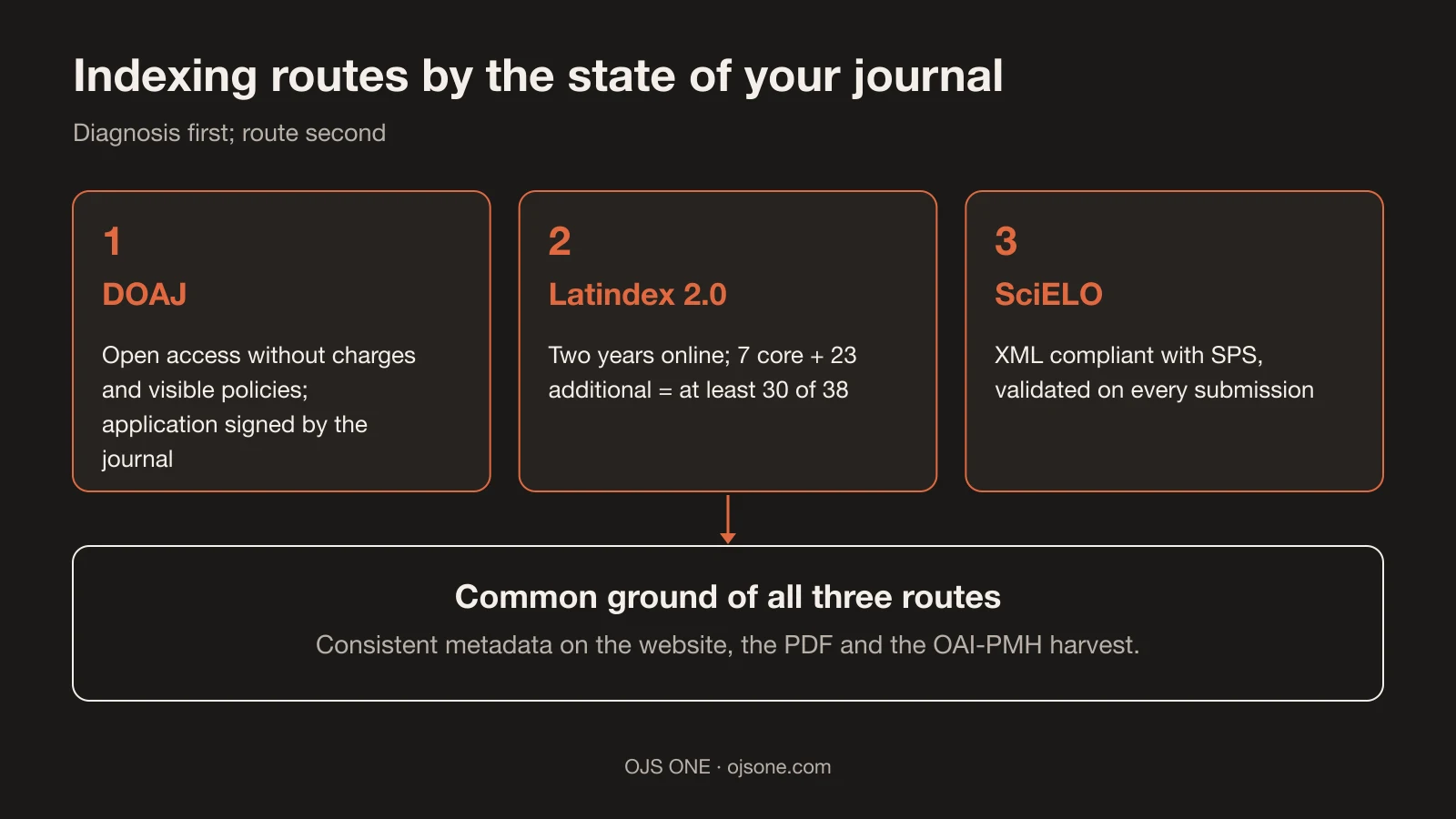
Direct answer: the route depends on three facts (age, type of access and declarations met), not on enthusiasm.
- Route 1: DOAJ first. If your journal is open access with no charges to read or to publish and already meets the basic visible policies, DOAJ is the most straightforward entry point: the process is governed by "the criteria in our Guide to applying"2, with open documentation. An added advantage: it enables the following routes (see below).
- Route 2: Latindex Catalogue 2.0. If your journal has "two years of age in its online version"3 and has an institutional or official website, applying to the Catalogue measures 38 characteristics: it "must meet the seven mandatory basic characteristics and at least 23 of the rest... for a minimum of 30"3 ("Each characteristic met is worth one point"3). An interlock detail: if your journal charges fees of any kind, Latindex only assesses it "unless it is indexed in the Directory of Open Access Journals (DOAJ) or in SciELO"3; at that point DOAJ stops being optional.
- Route 3: SciELO. If your journal is aiming at a SciELO collection, the underlying requirement is XML: "O arquivo XML que o SciELO necessita deve estar em conformidade com o SciELO Publishing Schema"4 (the XML file SciELO needs must comply with the SciELO Publishing Schema). Without the capacity to produce and validate compliant XML, that route stalls at submission.
- Combined routes. The reality of university portals is mixed: DOAJ as a declarative base, Latindex as regional recognition and SciELO when the collection and XML production allow it. Prioritize the one your real state makes achievable in the next semester.
Once the route is chosen, set an internal review date: the application is prepared against a calendar with owners, not against an intention. Rounds without a date postpone themselves, and every lost month is one more issue of delay.
What each route requires in practice
- DOAJ: guide read before submitting, basic criteria met, application signed by the journal and records kept up to date afterwards2. The review uses the published criteria of the guide2.
- Latindex: an institutional or official website where each characteristic can be verified, free access to content, two years online and the minimum of 30 points including the seven basic ones3. Characteristics are checked only with information visible on the journal's website3.
- SciELO: XML compliant with the SPS profile4, validated on every submission, plus the collection's editorial criteria. If today you only produce PDF, that gap is closed before applying, not during.
The same principle applies to all of them: the index verifies what your website declares and allows to be checked. If your OAI-PMH does not respond or your article metadata has gaps, the application reflects it (reviewable in Latindex and OAI-PMH interoperability and in article metadata in DOAJ).
Metadata: the common denominator of the three routes
Direct answer: what DOAJ, Latindex and SciELO end up looking at is the same set of data, declared consistently.
- One truth, three shop windows: title, authorship, affiliations, abstract, keywords and identifiers must say the same thing on the website, in the PDF and in the OAI-PMH harvest. Every difference is a reviewer's question.
- Persistent identifiers from the start: the Chilean diagnosis included "publication formats and persistent identifiers"1 as a dimension in its own right; a journal without persistent identifiers loses points on almost any route.
- No visible debt: broken metadata and missing DOIs are the first thing a reviewer notices and the cheapest thing to fix before submitting (diagnosis in broken metadata and missing DOIs).
- Consistency with the harvest: if your OAI-PMH exposes incomplete records, the index sees that before your page (how to check it in Latindex and interoperability).
The operational recommendation is simple: a single metadata curation process at the close of each issue, feeding the website, the repository and applications. It is done once and serves all three routes.
Checklist before applying to any index
Before each submission, go through this common check: the three routes end up requiring visible declarations, consistent data and continuity over time13, and none of that depends on the index chosen; it depends on your file.
- Diagnosis by dimension with status and owner per item (the format of the Chilean study is a good template1).
- Complete, visible editorial board, with named scientific responsibility.
- Peer review policy written and accessible from the website.
- ISSN, publication frequency declared and met, and author instructions.
- Persistent identifiers assigned to published articles.
- Preservation declared and with a real mechanism (see digital preservation in OJS).
- Working OAI-PMH harvest and complete article metadata.
- Charges, if any, declared plainly and with DOAJ/SciELO as enablers as appropriate3.
- A current institutional email account, checked by a responsible person, to receive process communications2.
Common mistakes when choosing a route
- Applying to the "most prestigious" index without meeting the basics of any.
- Fixing the website halfway: what is not declared verifiably does not score3.
- Ignoring the DOAJ–Latindex interlock for journals with charges3.
- Treating indexing as a one-off campaign: without maintaining records, the journal loses what it gained2.
- Promising internal indexing dates: the decision always belongs to the index.
- Skipping the diagnosis out of "urgency": it is the most direct way to find out how much the chosen path really costs.
- Updating policies on the website but not in the index record (or vice versa): the discrepancy is the first thing a reviewer detects.
- Leaving preparation to the last minute: every round submitted without a complete file is a lost semester.
Frequently asked questions
What is the fastest route for a new university journal?
There are no shortcuts: Latindex requires two years online3 and DOAJ requires its basic criteria to be met2. For young journals, the productive route is to prepare declarations and metadata from the first issue and aim for DOAJ when the file is complete.
Can I apply to DOAJ and Latindex at the same time?
Yes, and for journals with charges they are complementary: Latindex assesses those journals only if they are in DOAJ or SciELO3. Prepare the declarative base once and adapt each application to the corresponding form, with the same evidence behind it.
Does SciELO ask for different things than DOAJ?
Yes: SciELO asks for technical compliance with SPS in the XML4 and its own editorial criteria; DOAJ assesses policies, transparency and metadata2. A journal with both goals needs both layers of work.
Conclusion. Choosing a route without a diagnosis is gambling; with a diagnosis, it is planning. If you want us to review your journal across those eight dimensions and hand you the prioritized route with evidence, that is the core of the OJS 360 Assessment; write to us and we will start there.
Sources
- Universidad de Chile. U. de Chile evaluó 67 revistas científicas de universidades estatales y entregó lineamientos para su indexación. https://uchile.cl/noticias/243664/u-de-chile-evaluo-67-revistas-cientificas-de-universidades-estatales (accessed 18 November 2026). Quotations translated from Spanish.
- DOAJ. Publisher information. https://doaj.org/apply/publisher-responsibilities/ (accessed 18 November 2026).
- Latindex. Guía de calificación del Catálogo 2.0 (versión 8). https://www.latindex.org/latindex/postulacion/postulacionCatalogo (accessed 18 November 2026). Quotations translated from Spanish.
- SciELO. Perguntas Frequentes Sobre a Adoção de XML. https://docs.scielo.org/projects/scielo-pc-programs/en/latest/faq-scielo-xml.html (accessed 18 November 2026).
OJS 360 Assessment
Before applying, know exactly what is missing
We review metadata, DOIs, OAI-PMH, policies and preservation against what DOAJ, Latindex and SciELO ask for, and hand you a prioritized route with owners.
- Evidence-based diagnosis by dimension
- Prioritized route and correction plan
- Indexing decisions always belong to the index
OJS 360 Assessment
Before applying, know exactly what is missing
We review metadata, DOIs, OAI-PMH, policies and preservation against what DOAJ, Latindex and SciELO ask for, and hand you a prioritized route with owners.
Request a diagnosis