Having a journal indexed in DOAJ does not automatically mean that its articles appear there. Publishers submit article metadata after the journal is indexed, and they are responsible for its quality. A practical workflow covers submission, corrections and periodic review.12
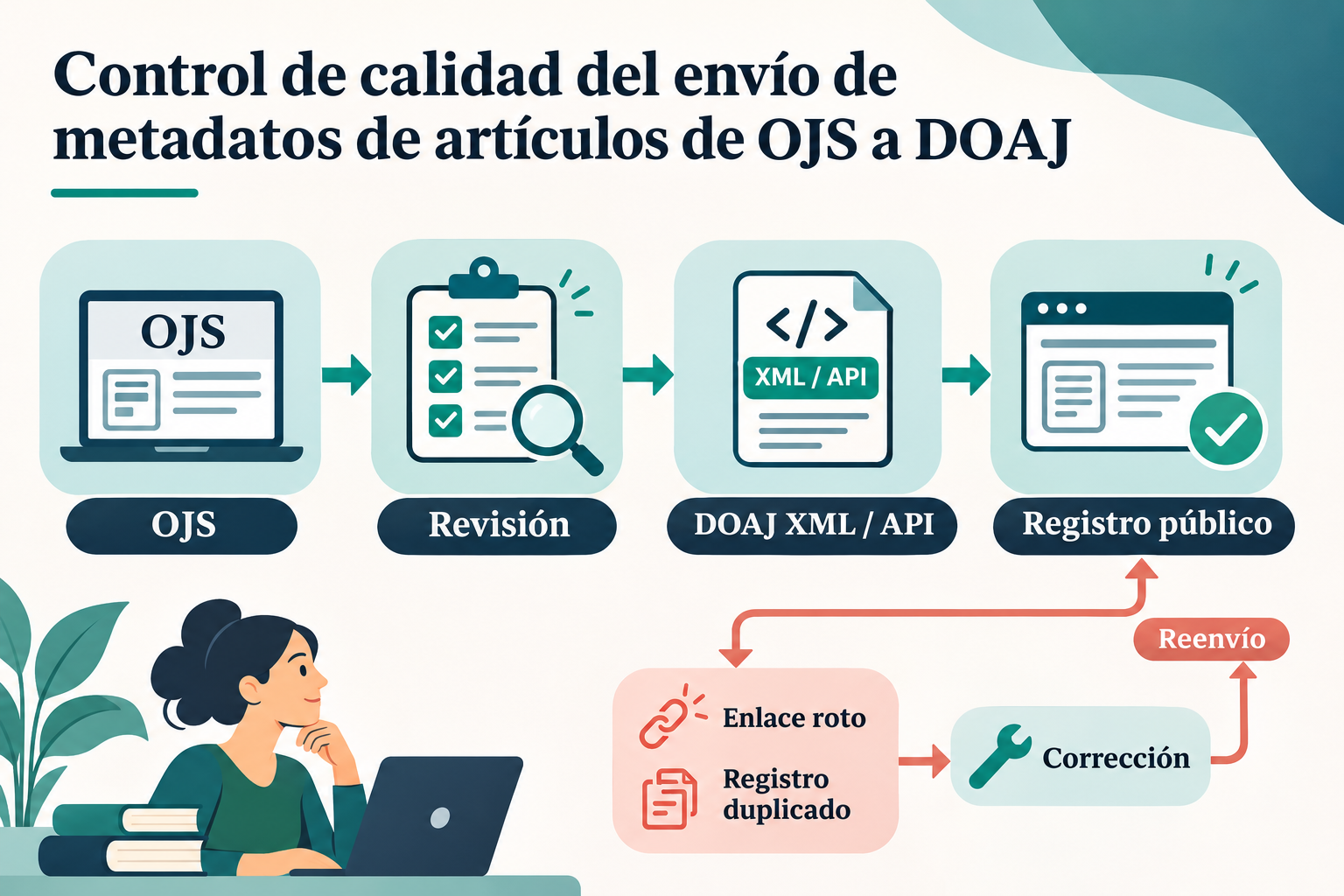
Choose a submission method
DOAJ accepts metadata through its API in JSON, as a DOAJ or Crossref XML file, or through a manual form.1 OJS offers a plugin for the workflow; consult the documentation for the version installed at your journal. Manual entry can be useful for a small number of records, while a repeatable export or API connection is easier to manage for regular issues.
If a large upload times out, DOAJ recommends splitting it into smaller files. Keep the exported file, the date and the result so the editorial team can identify what was submitted.
Check the fields before sending
DOAJ's XML documentation lists the journal title, publication date, article title and full-text URL among required elements. DOI and ORCID are optional in that schema, but contribute useful identification when available.2 Check that the ISSNs match the journal's DOAJ record and that the full-text URL opens the intended article. DOAJ asks publishers not to send author email addresses.1
Compare the exported record with the approved article: title, author names, affiliations, publication date, pages and identifiers. A record can be technically accepted and still contain an editorial error.
Correct records without creating duplicates
DOAJ uses the full-text URL and, where present, the DOI to identify articles. Resubmitting a record with the same identifiers can update its metadata. If the full-text URL or DOI must change, contact DOAJ before uploading: changing an identifier through a new submission can create a duplicate.1
Before a migration or domain change, list affected articles, document their old and new identifiers, ask DOAJ for its current procedure, and check the resulting records. Deleting article metadata has serious consequences, so follow DOAJ's instructions for the specific case.
Languages, affiliations and ongoing review
The current DOAJ guidance describes limits for multilingual titles and abstracts and for representing several affiliations per author. Check the current instructions before export; these capabilities may change.1 DOAJ has also announced work on richer article metadata, including affiliations and organizational identifiers.3
DOAJ warns that problematic or incorrect article records may be removed and that account contacts should respond to notifications.1 Keep the account email monitored and check a sample of full-text links regularly.
For each quarter, confirm that new issues were submitted; compare a sample of titles, authors, affiliations and dates; open the full-text links; check DOI consistency; and record corrections and their owner. Repeat the sample for each journal in a multi-journal portal.
OJS ONE's OJS 360 Assessment reviews metadata quality alongside DOI, OAI-PMH and policies and delivers a prioritized correction plan, and the managed OJS plans keep exports and checks with a single team. DOAJ's decision about your journal never depends on OJS ONE.
Frequently asked questions
Does DOAJ automatically collect every article after a journal is indexed?
Publishers are expected to submit article metadata. Journal indexing and article submission are separate steps.1
Can a title or author be corrected?
DOAJ explains how to update existing records. Keep the identifiers consistent and consult DOAJ before changing a DOI or full-text URL.1
Does successful ingestion guarantee editorial accuracy?
No. The publisher must check the accuracy of the metadata it submits.2
Sources
OJS 360 Assessment
Before applying, know exactly what is missing
We review metadata, DOIs, OAI-PMH, policies and preservation against what DOAJ, Latindex and SciELO ask for, and hand you a prioritized route with owners.
- Evidence-based diagnosis by dimension
- Prioritized route and correction plan
- Indexing decisions always belong to the index
OJS 360 Assessment
Before applying, know exactly what is missing
We review metadata, DOIs, OAI-PMH, policies and preservation against what DOAJ, Latindex and SciELO ask for, and hand you a prioritized route with owners.
Request a diagnosis