
Digital preservation in OJS: how to check that your journal is archived
How to check digital preservation in OJS with evidence: deposit, status per issue, external registry, owners and the difference between a backup and an archive.
Digital preservation in OJS aims to keep published articles available if the journal, its provider or its platform stops operating. It is not the same as having a backup: the journal must verify what content is deposited, where it is registered and who reviews that status.
OJS can integrate with preservation networks. The relevant work does not end when a plugin is enabled. You must keep evidence that published issues entered the agreed mechanism and define a response when that evidence reveals a gap.
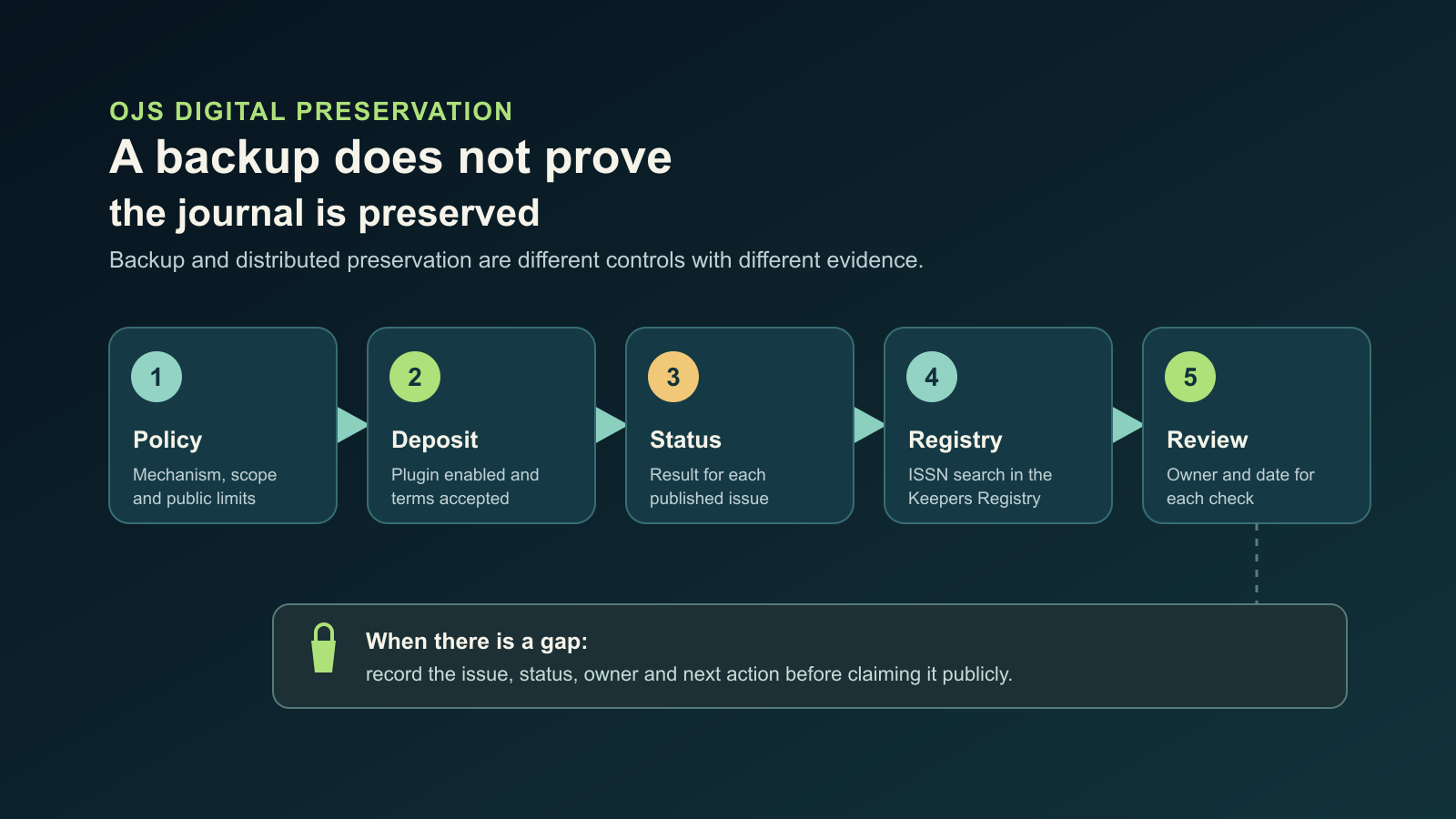
Original diagram. A backup does not prove the journal is preserved: each check needs its own evidence.
Preservation, backup and availability solve different problems
A backup lets you rebuild an operation: database, files, configuration and other items defined in its scope. It is an operational continuity measure. Its quality depends on what is backed up, where it is stored, how long it is kept and whether restores are tested.
Digital preservation has another purpose: to protect the published scholarly record over the long term through a mechanism independent of the site that displays it. A copy of the portal on the same server or in the same cloud account does not prove that independence. Neither do a DOI, OAI-PMH exposure or presence in an index replace a preservation archive.
LOCKSS explains that its nodes compare copies with each other after ingest and can coordinate repair if they detect loss or damage.[2] That logic illustrates why a distributed scheme is not equivalent to keeping a second backup file to quickly restore the portal.
You should not choose between backup and preservation. A journal needs both controls, with separate objectives, owners and evidence.
What PKP Preservation Network preserves and when it is used
PKP Preservation Network (PKP PN) is a preservation network for OJS journals based on LOCKSS. PKP states that it preserves content generated through OJS export tools, automatically ingests new content from registered journals and makes it accessible after a trigger event.[1]
The model is a dark archive: the preserved copy is not an additional public version of the site while the journal operates normally. When a trigger event applies, the preserved content can be loaded into OJS instances of institutions that participate in the network.[1]
To take part, PKP declares minimum conditions: a compatible OJS version, an ISSN and at least one published article. The administrator must install and enable the PKP PN plugin and accept the preservation terms.[1]
These conditions do not by themselves show that a journal is preserved. They only enable the process. The check must consider the status of deposits, the coverage of historical issues and the external evidence available.
The four pieces of evidence to ask for before claiming it publicly
A credible preservation policy can be short, but it must link a public claim to operational records. Review these four pieces.
- Public preservation policy. It must identify the mechanism used, what content it covers, its limits and how the information is kept current. Avoid phrases like "our files are safe" without naming a verifiable process.
- Deposit mechanism. Verify that the plugin or service is enabled, that its terms are accepted and that published issues enter the flow. For PKP PN, the deposit relates to content published from OJS.[1]
- Status per issue. A configuration screen is not enough. Ask for the status of the deposited units and distinguish between a submission started, one pending and one confirmed by the network, according to the information the service provides.
- External registry and owner. Search for the journal by ISSN or title in the Keepers Registry and record who reviews that evidence periodically. The registry gathers holdings data reported by participating archiving agencies.[3]
These checks serve an internal audit, a hosting renewal or a review of an editorial policy. They do not guarantee an identical result for any future contingency; they let you show that a mechanism exists and that it is monitored.
How to check preservation status in OJS without mixing up stages
The review starts in the plugin or service panel, not in an institutional text. Open the status and read the result for each published issue.
The path usually includes package generation, transfer, processing and confirmation by the network. The exact names of the stages may depend on the version and the mechanism. Keep a screenshot or record of the date, the issue, the observed status and the person who did the review.
The operational question is not "is the plugin enabled?". It is: "which recent and earlier issues have a satisfactory status, which are pending, and what documented explanation exists for each gap?".
If the journal publishes continuously by article, confirm how issues are formed and how the deposit works with the current configuration. Do not assume an individual file is preserved just because it is visible on the site. The evidence must be reviewed against the concrete editorial model.
Verify preservation outside your server
Local verification shows the process from the portal. External verification adds independence: the status does not depend only on whoever administers the same site.
The Keepers Registry lets you search by ISSN or title and check a journal's archiving status. The registry states that it receives metadata about holdings from preservation agencies and recommends reviewing the details of each initiative directly.[3]
Include these checks in an institutional spreadsheet:
- ISSN used for the search and review date.
- Mechanism declared in the public policy.
- Issues with a satisfactory status in the local panel.
- External result found, if any, and the date of the record.
- Editorial and technical roles responsible.
- Action defined when there is a gap, for example a published issue that does not appear as deposited.
An external registry may update on a different cycle from the OJS panel. That is why a temporary absence does not automatically prove a failure. Compare it with the local deposits and, if it persists, investigate before making a public claim.
A preservation policy must say what it covers and what it does not
A useful policy does not need to promise absolute permanence. It must explain the mechanism, the scope and the review procedure. For example, it can state that the journal uses a distributed preservation network for published issues and keeps separate backups to recover the editorial operation.
It must also avoid two mistakes. The first is presenting a preservation network as a copy ready to rebuild the whole site after any incident. The second is asserting that the external registry updates in real time without checking how the relevant agency publishes its holdings.
Transparency helps authors and libraries understand the real scope of the measure. It does not turn preservation into a guarantee of indexing, nor does it replace access, ethics or institutional continuity policies.
DOAJ also distinguishes preservation routes: one for OJS journals through PKP PN, another through upload to CLOCKSS and a web-harvesting alternative in its JASPER initiative.[4] The choice depends on the conditions of the journal, the platform and the criteria of each service.
Mistakes that leave a gap even when the plugin is installed
Confusing a backup with distributed preservation. A backup recovers operational services; a distributed archive protects the published record for a different purpose. Design and test both controls.
Reviewing only the initial configuration. A correct installation does not confirm that later issues reached a satisfactory status. Review the results per issue after each relevant editorial cycle.
Not assigning an owner. If the policy says "the journal" will verify the service, nobody is in charge when the editor, the provider or the IT staff changes. Define a role, a review date and an escalation channel.
Publishing a claim without external evidence. Saying a journal is preserved requires the institution to be able to show the mechanism, the local status and, when it exists, a verifiable external record.
Forgetting the back catalog. Enabling a network today does not remove the need to review issues already published. Confirm the retrospective coverage the mechanism declares and record the actual results.
OJS operations must include a periodic review
Digital preservation touches the platform, but it does not end at the platform. It involves OJS version, ISSN, publication of issues, administrative accounts, status reviews, backups and institutional policies.
OJS administration with clear responsibilities lets you separate day-to-day continuity from long-term preservation. Changes of version, domain or infrastructure must consider the deposit mechanism and not be limited to checking that public pages still load.
Quarterly review procedure
- Record the issues published since the last review.
- Review the deposit status of each issue in the plugin or contracted service.
- Compare the result with the public policy and with the ISSN search in the Keepers Registry.
- Open a gap log: issue, date, observed status, owner and next action.
- Confirm that operational backups are managed through a separate path and that there is evidence of a tested restore.
- Update the policy only if the mechanism, scope or owner changes.
This procedure does not require announcing perfect results. It lets you detect early an expired configuration, a platform change, a publication without a deposit or a policy that no longer matches the real operation.
OJS ONE offers specialized operations for OJS journals. In a continuity review, the service can organize platform, backup and preservation responsibilities so the institution can assess its real evidence. The chosen mechanism, its conditions and its validation still depend on the journal and the external services involved.
Frequently asked questions
Does PKP PN replace OJS backups?
No. PKP PN is a mechanism to preserve published content under a distributed scheme. Database, file and configuration backups are still needed to recover the journal's operation.
Is enabling the plugin enough to say a journal is preserved?
No. You must review the deposit status per issue, confirm the historical coverage and keep external evidence when it is available. Enabling starts a flow; it does not replace the check.
Does the Keepers Registry confirm a new publication immediately?
Not necessarily. Compare the external result with the local status and the publication date; each agency reports its holdings on its own update cycle.
Closing
A prepared journal does not depend on a single copy, a single person or a single statement on its site. It combines an operational backup, distributed preservation, external evidence and a review assigned to specific owners. If you need to organize these controls together with your journal's operations, updates and continuity, see OJS ONE operations.
Sources
- Public Knowledge Project, PKP Preservation Network — accessed 2026-10-29.
- LOCKSS Program, How LOCKSS Works — accessed 2026-10-29.
- ISSN International Centre, The Keepers Registry — accessed 2026-10-29.
- DOAJ, JASPER preservation service — accessed 2026-10-29.
Is your journal struggling with slow performance or recurrent outages?
Contact our team and see how enterprise-grade infrastructure can transform your editorial operation.
Request assessment