Before applying to DOAJ, read this: DOAJ asks you not to pay an intermediary ("we advise not talking to or paying an intermediary to help you get indexed in DOAJ"1) and that the journal itself submits the application. What can be delegated is the preparation: metadata, policies and a consistent website. This piece separates what the journal does, what a provider can prepare and what the process reviews.
If you are already worried about the state of your metadata, our piece on article metadata in DOAJ covers correcting published records; here we deal with the application itself.
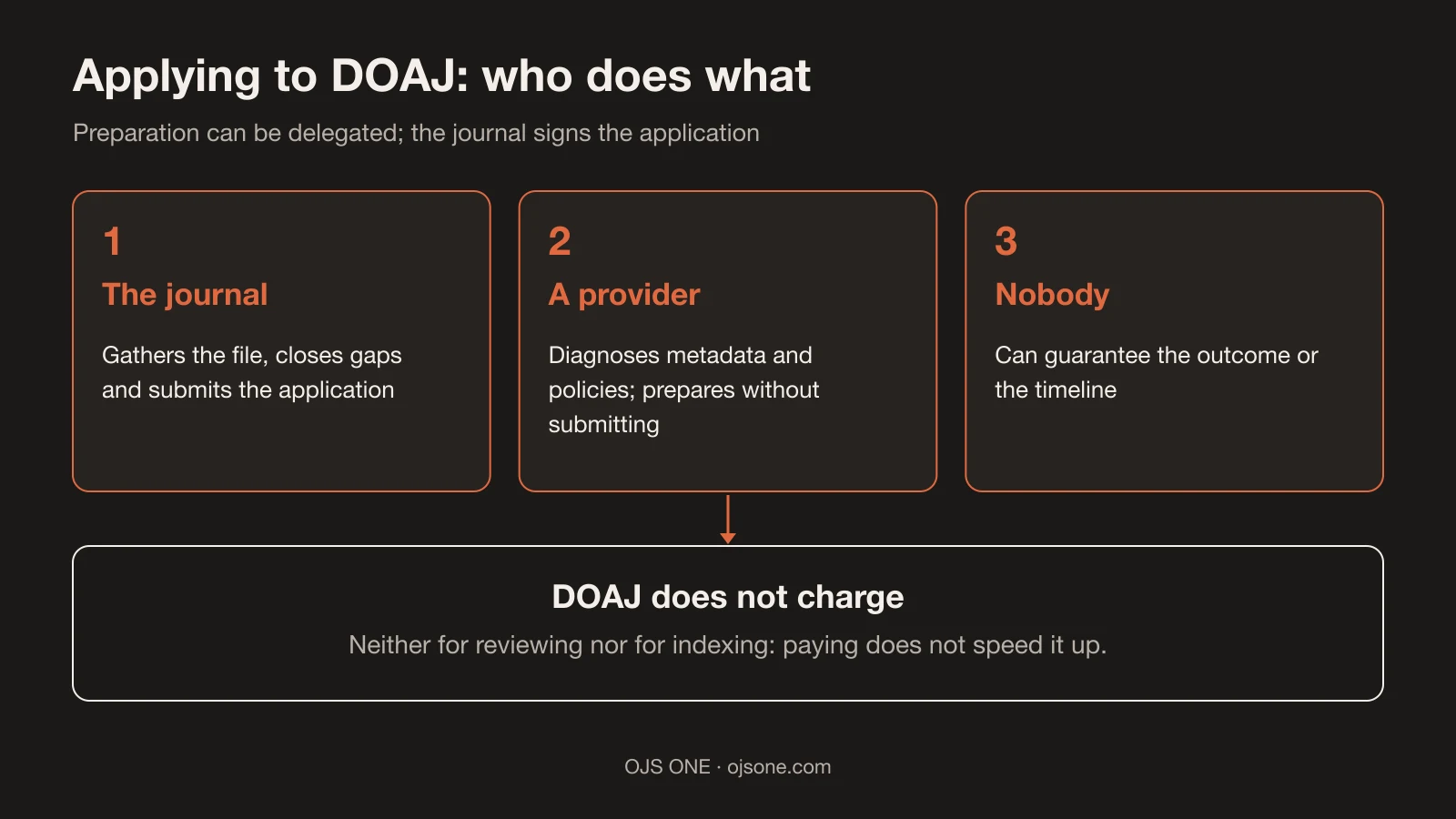
What to prepare to apply to DOAJ without intermediaries
Direct answer: prepare your journal's file; submit the application yourself.
DOAJ makes all its documentation openly available ("Our website contains all the information you need in its Guide to applying"1) and warns about the risk of paying for it: "there is no guarantee that they can deliver what they promise"1. Within that framework, the preparation work splits into three fronts:
- The journal does and signs: gathering the file (visible policies on peer review, open access, preservation and charges, an editorial board with names, author instructions, ISSN, publication frequency), closing whatever gaps it finds and submitting the application: "someone directly affiliated with the journal or its publisher/platform should submit the DOAJ application"1.
- A provider can prepare (without submitting): diagnosing metadata and its OAI-PMH harvesting, reviewing policies against the guide, correcting published records, aligning the website with what the guide checks. It is measurable work, with verifiable deliverables: exactly the kind of thing we do in the OJS 360 Assessment.
- Nobody can promise: neither the outcome nor the timeline. Nobody decides on DOAJ's behalf.
What DOAJ charges and what it will never charge
Direct answer: nothing for reviewing or indexing.
The official page states it: "No charge - we do not charge fees for reviewing or indexing your applications"2. And the blog reinforces the rule: "Nobody working or volunteering for DOAJ will ask for payment linked to assessing an application or indexing a journal"1.
That is why any paid offer of "end-to-end management of your application" deserves concrete questions: who will sign the application (it must be someone from the journal1), what happens if the journal is not indexed (DOAJ warns that intermediaries "do not publicise when their clients are not indexed"1) and what real control they have over the process, which belongs to DOAJ and its editorial team of volunteers1.
What the process reviews and what happens next
Direct answer: guide, criteria, waiting and ongoing updates.
- Before submitting: read the official guide and check that the journal meets the basic criteria1.
- If the result is a rejection: you receive an email with the reason and the waiting period before reapplying ("an email explaining why and how long you must wait before applying again"2). That email is your correction list; there is no shortcut.
- If the result is acceptance: the work continues: "You will inform us of changes to your journals and keep your journal records up to date"2. Changes of URL, charges, policies, inclusion in a digital archive or use of DOIs must be reported2.
- With the journal indexed: uploading article metadata becomes routine (field-by-field details are in our DOAJ metadata piece).
In Latin America support exists and is free: DOAJ has ambassadors for the region and runs workshops "designed to demystify the DOAJ application process"3; local reality varies from country to country ("change drastically from country to country, university to university, and discipline to discipline"3), so it is worth using that route before any paid service.
What DOAJ reviews on your website (and what you can check today)
Direct answer: visible policies, up-to-date records and consistency between what is declared and what is practised.
Before submitting, go through your website as a reviewer would:
- Complete, linked policies: peer review, open access, charges (or their declared absence), preservation, ethics and copyright. What is not visible cannot be assessed.
- Up-to-date records: DOAJ comes back to concrete changes: "When your journal is included in a digital archive, starts using DOIs, or has registered a deposit policy"2, your record must be updated.
- Emails that arrive: communications about the process go to the registered account; check filters and spam in advance2.
- Correct use of the logo: once indexed, "You may use the DOAJ logo on your journal's website but not on individual articles"2, a small detail that reveals whether someone read the rules.
- Accessible archives: issues and articles individually available from the journal's own website, with stable links.
This walk-through can be done in an afternoon with the guide open1; it is the same checklist we apply in a contracted preparation.
The minimum file your journal must have
Direct answer: eight pieces that must exist and be visible before applying to DOAJ:
- Journal identity: ISSN, declared publication frequency, scope and editorial board with names1.
- Author guidelines with submission and review instructions.
- Peer review policy, with the process described.
- Open access and charges policy, including the statement that there are none.
- Preservation policy with a named mechanism2.
- Code of ethics and handling of conflicts of interest.
- Metadata for published articles, complete and consistent with the PDFs4.
- Technical evidence: a stable website, links that respond and working OAI-PMH harvesting.
With that file, applying stops being a gamble and becomes a delivery. If the file has gaps, the order of attack is: first policies and board (what the guide checks), then metadata and links (what the reviewer will see), and only then the application.
What a professional preparation measures well
If you hire support to prepare (not to submit), require deliverables you can verify yourself:
- A diagnosis against the guide, item by item, with status and owner.
- A list of missing or incomplete policies on the website, with proposed text.
- A review of published article metadata: mandatory fields, links and consistency with the PDFs4.
- The state of the OAI-PMH harvest and of the journal's persistent identifiers.
- A correction plan with dates, executable by your team even if the provider disappears.
A sign that the preparation worked: the application goes out with no pending form questions, and every answer from the team rests on a dated deliverable, not on the memory of whoever was there last time.
If the provider does not deliver that, you are buying optimism.
Common mistakes when applying
- Delegating submission to a third party: DOAJ rejects the practice and asks the journal to sign1.
- Paying to "guarantee" indexing: nobody guarantees what DOAJ's committee decides.
- Submitting without reading the guide: 100% of the information is open1; skipping it only guarantees a wasted round.
- Hiding charges or policies: consistency between what the website says and what the journal practises is part of the criteria2.
- Applying and forgetting: once indexed, records must be maintained2, as we saw in preservation and visible policies.
- Fixing only what the rejection flagged, without reviewing the whole guide: the next round finds the same issues.
- Leaving process emails in spam: DOAJ's notices arrive at the journal's registered account2, and missing them can cost deadlines.
- Registering the editor-in-chief's personal email instead of an institutional account: when that person changes jobs, the journal loses its official channel with DOAJ2.
Frequently asked questions
Can a provider submit my application to DOAJ?
No. DOAJ requires it to be submitted by someone directly affiliated with the journal or its publisher/platform, not a third party acting on your behalf1. What you can hire is all of the preparation.
Does paying speed up the process?
No. DOAJ does not charge for reviewing or indexing2, and nobody at DOAJ accepts payments for assessment1. The process is run by its editorial team with volunteers, on its own timeline.
What do I do if I am rejected?
Read the email with the reason and the waiting period, correct against the guide (not only the flagged item) and reapply when the period allows2.
Conclusion. Applying well means arriving with a complete file and an application signed by the journal; paying for the paperwork does not change the verdict. If you want a serious diagnosis against the guide (metadata, policies, harvesting and gaps), that is part of the OJS 360 Assessment; you can also write to us.
Sources
- DOAJ Blog. Applying to be indexed in DOAJ? Start with us. https://blog.doaj.org/2026/11/09/applying-to-be-indexed-in-doaj-start-with-us/ (accessed 18 November 2026).
- DOAJ. Publisher information. https://doaj.org/apply/publisher-responsibilities/ (accessed 18 November 2026).
- DOAJ Blog. Listening to the landscape: My six-year journey as DOAJ Ambassador for Latin America. https://blog.doaj.org/2026/11/16/listening-to-the-landscape-my-six-year-journey-as-doaj-ambassador-for-latin-america/ (accessed 18 November 2026).
- OJS ONE. Article metadata in DOAJ. https://ojsone.com/en/resources/doaj-article-metadata-submission-corrections (accessed 18 November 2026).
OJS 360 Assessment
Before applying, know exactly what is missing
We review metadata, DOIs, OAI-PMH, policies and preservation against what DOAJ, Latindex and SciELO ask for, and hand you a prioritized route with owners.
- Evidence-based diagnosis by dimension
- Prioritized route and correction plan
- Indexing decisions always belong to the index
OJS 360 Assessment
Before applying, know exactly what is missing
We review metadata, DOIs, OAI-PMH, policies and preservation against what DOAJ, Latindex and SciELO ask for, and hand you a prioritized route with owners.
Request a diagnosis