OpenAlex uses information from multiple sources to make research discoverable. PKP reported in October 2026 that approximately 95% of active OJS journals had articles in OpenAlex; some remaining gaps involved access to journal servers.1 Coverage does not guarantee that every article or metadata field is correct.
Start with the journal record
Search OpenAlex by journal title and ISSN. Confirm that the source represents your journal and inspect a sample of recent articles. Compare titles, authors, affiliations, dates and DOIs with the published versions. Record missing items and their publication dates.
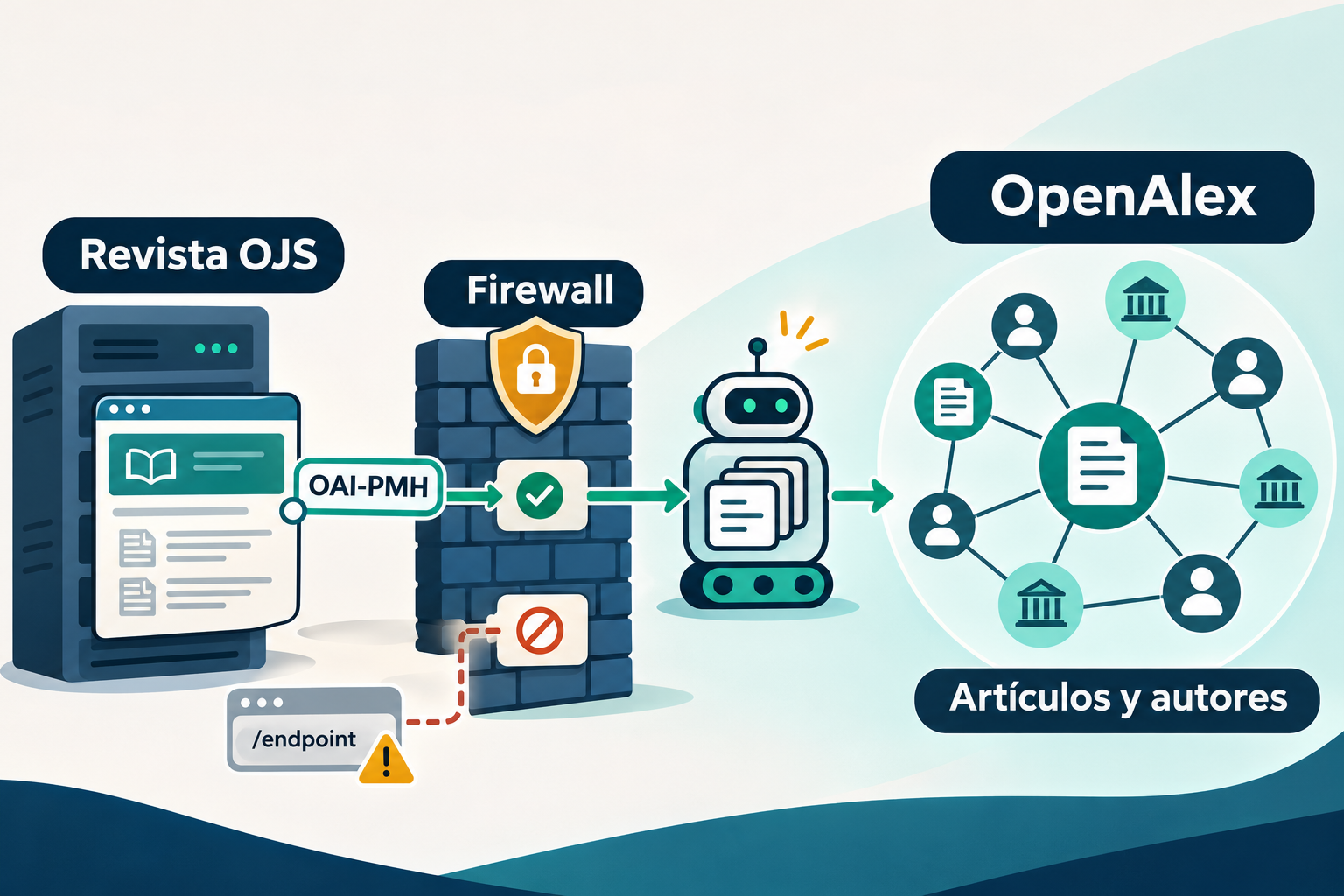
OpenAlex can receive article data through Crossref and can harvest OAI-PMH endpoints. Its guidance explains that an OJS journal's endpoint can also be registered for harvesting.2 If information is missing or wrong, collect examples and contact OpenAlex with the journal's ISSN and relevant URLs.
Check the OAI-PMH endpoint
OpenAlex documents a set of checks for harvestable endpoints.2 Ask your technical provider to record the results:
- Open the journal's OAI-PMH base URL with
verb=Identify; it should return an OAI-PMH XML response. - Request records using
verb=ListRecords&metadataPrefix=oai_dcand inspect a representative sample. - Confirm that anonymous requests can reach the endpoint and that responses arrive within the timeout described by OpenAlex.
- Check the earliest datestamp and that records contain the title and DOI information needed for matching.
- Save the response, time and any error message for diagnosis.
The endpoint commonly follows the pattern /index.php/journal/oai, although the actual address depends on the installation. A public page loading successfully does not prove that automated harvesting can reach this endpoint.
Review security controls carefully
A firewall, WAF, geographic rule, rate limit or bot challenge can block a legitimate harvester. Check access and error logs before changing a rule. OpenAlex publishes the current harvester identification and network details in its documentation; verify them at the time of the change rather than relying on an old address.2
Limit any exception to the required service, document who approved it, and set a date for review. Keep the technical contact address current so that requests from the harvesting service reach someone who can act.
Improve metadata at the source
Crossref registration is an important route for journal articles, but a DOI alone does not prove that titles, affiliations and other fields are complete. Compare what is published on the journal website with Crossref and OpenAlex. Correct the source record and follow the relevant service's correction process.
After a server or metadata correction, record the date and check again after harvesting has had time to run. If a problem persists, send OpenAlex the ISSN, endpoint, example article URLs or DOIs and the evidence from your checks.
To check whether harvesters actually receive all your records, run the free OAI-PMH validator for OJS. With the managed OJS plans, the same team that runs the server reviews firewall rules and the OAI-PMH endpoint, so security changes don't cut your journal off from harvesting services.
Frequently asked questions
Must every OJS journal register an endpoint?
OpenAlex receives journal information through more than one route. Its documentation explains how an OJS OAI-PMH endpoint can be registered when needed.2
Is appearing in OpenAlex enough?
No. Review individual records for completeness and accuracy, including author names, affiliations and publication details.
Does inclusion guarantee a ranking outcome?
No. Inclusion improves the availability of metadata; each evaluation or ranking uses its own methods.
Sources
OJS 360 Assessment
Before applying, know exactly what is missing
We review metadata, DOIs, OAI-PMH, policies and preservation against what DOAJ, Latindex and SciELO ask for, and hand you a prioritized route with owners.
- Evidence-based diagnosis by dimension
- Prioritized route and correction plan
- Indexing decisions always belong to the index
OJS 360 Assessment
Before applying, know exactly what is missing
We review metadata, DOIs, OAI-PMH, policies and preservation against what DOAJ, Latindex and SciELO ask for, and hand you a prioritized route with owners.
Request a diagnosis