Institutional research repositories are no longer a differentiator: they are basic infrastructure for academic output. The useful question is not how many documents it shows, but which decisions sustain it (deposit policy, complete metadata, interoperability and preservation) and how it connects with the journal the same institution publishes in OJS.
The region has cases with more than a decade of history and, in Chile, since October 2025 a national node that harvests repositories has been operating. This piece sets out what to require of yours and what to review before building one. If your journal also needs to put its identifiers and exposure in order, see digital preservation in OJS.
What institutional repositories are and what they are not
Direct answer: the digital archive where an institution gathers, preserves and disseminates in open access what it produces (theses, articles, books, reports, data).
What sets it apart is standardized metadata and persistent identifiers that make its documents findable and citable over time. It is not a journal portal (which groups publications from many institutions) nor an ordinary website: it organizes documents, not pages.
That distinction matters because blurring it confuses decisions: the repository preserves and gives visibility to the institution's entire body of work; the journal, published in OJS, is a collection with its own editorial workflow. Both share the same metadata discipline, and that is where the opportunity to run them with common criteria lies.
What to require: the foundation of a repository that works
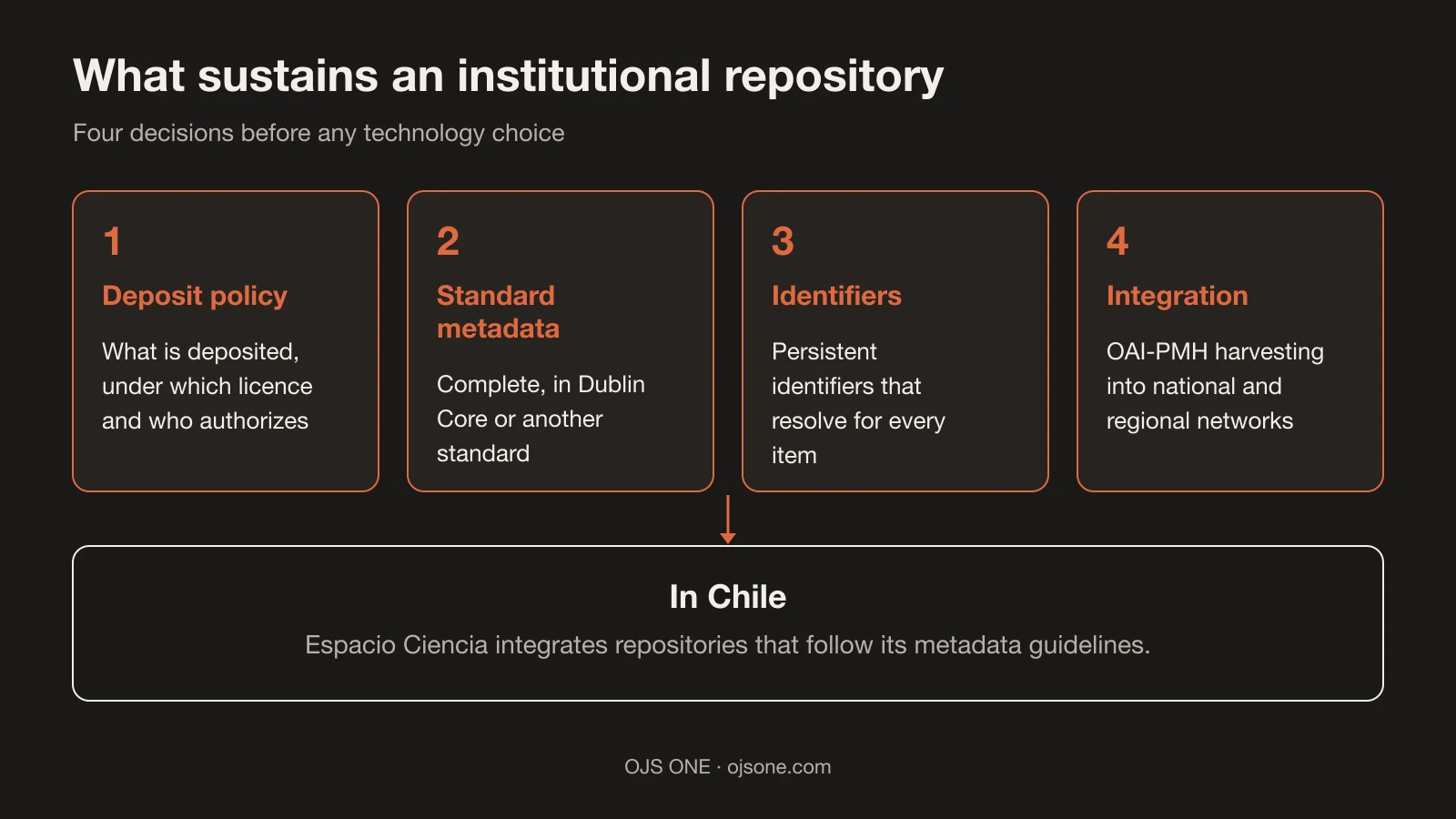
Direct answer: four decisions before any technology choice.
- A written deposit policy: what is deposited, under which licences and who authorizes. It can take the form of a resolution, a regulation or a law. Without it, the repository depends on each author's goodwill.
- Complete, standard metadata: complete and under a standard such as Dublin Core, which is what allows other networks to harvest and re-present the content.
- Permanent links and identifiers: every document locatable over time, with well-declared persistent identifiers (DOI, handle, ARK).
- Integration with networks: an isolated repository is a nice private archive; connected to national and regional networks it is infrastructure. Global directories such as OpenDOAR already list thousands of open access repositories: the conversation is no longer whether one exists, but with what quality you are in it.
Add long-term preservation to that: retention policies, formats and authenticity. In Chile, the public framework is explicit: the "Digital Preservation Policy 2026-2029 establishes the principles, responsibilities and guidelines that will guide the reception, preservation and access"1 of electronic records of State bodies, in the context of "Law No. 21.180 on the Digital Transformation of the State"1.
The Chilean layer: nodes, guidelines and why they affect you
Direct answer: in Chile your repository does not connect to nothing: it connects to a national node with metadata guidelines.
Since October 2025 "Espacio Ciencia, Chile's national access node, has been in operation"2, a single access point to the scientific output hosted in the participating institutions' repositories. The entry condition is about metadata: "integrated repositories follow Metadata Guidelines and Interoperability Mechanisms"2. The underlying policy has been in force in the country "since May 2022"2.
In practical terms: if your institution publishes research (including that of your journals), the quality of your metadata determines whether you appear in the national access window. Before buying or setting up a platform, check that your instance's schema, mandatory fields and OAI-PMH harvesting meet those guidelines.
And if you are a public institution, the National Archive has published the preservation policy that applies to you1: read it before defining retention and formats, not after the first audit.
How it connects with your OJS journal
Direct answer: through metadata and preservation, not through the platform.
- Same discipline, two destinations: your journal's articles need the same complete metadata the repository requires; what you already curate for the journal can be deposited in the repository without rework.
- Separate exposure: your OJS exposes content via OAI-PMH to services and networks (the state of that exposure is reviewed in Latindex and interoperability); the repository exposes its entire collection. They are different doors to the same building.
- Complementary preservation: the repository preserves theses, datasets and documents; the journal preserves its issues. Both policies are written together, with consistent criteria for licences and identifiers.
- Shareable operation: whoever runs the journal portal can also run the repository with fewer handovers between parties; a single team with institutional context is easier to coordinate than three separate providers.
If your institution is considering setting up or rebuilding its repository, we can review scope, architecture and operation together with your journal portal.
What to look at before choosing a platform
Direct answer: four questions that no product's spec sheet answers for you.
- Real scale: how many documents and collections will you have in three years? Size defines storage, search index and curation effort, and it is almost always underestimated at the start.
- Community governance: who creates collections, who approves deposits and who resolves metadata conflicts. A powerful platform with nobody in charge becomes a dead deposit.
- Preservation and formats: what happens to the files in ten years (formats, copies, authenticity). Ask the provider directly, with the State's preservation policy as a reference framework1.
- Real interoperability: OAI-PMH working and verifiable, mandatory fields aligned with the guidelines that apply to your institution2, well-issued persistent identifiers? Ask for a harvesting test before signing, not a list of standards in the presentation.
With those four answers you compare proposals on equal terms; without them, you compare screenshots.
How to check that the repository works
Direct answer: with operational indicators, not front-page pride.
- Recent deposits: did documents come in during the last quarter? The deposit policy is measured by what arrives, not by what was signed.
- Complete fields: the percentage of records with abstract, affiliation, date and identifier. Incomplete ones are not a cosmetic error: they mean absence from the networks that harvest.
- Active harvesting: check that the instance responds to OAI-PMH and that the node or network you take part in is receiving updates2.
- Links that respond: persistent identifiers that resolve, for every document, without exception.
- Usage review: discovery and downloads per collection, read monthly, to decide with data where curation is missing.
This last point connects with running the journal: if you manage both worlds, the monthly review can be a single one.
Common mistakes when building or assessing a repository
- Choosing the platform before the policy: DSpace, Dataverse or another solution answer decisions that have not yet been taken.
- Leaving deposit to goodwill: without a policy and without support, the repository empties out in the first semester.
- Incomplete metadata: without mandatory fields and persistent identifiers, you are neither harvestable nor findable.
- Ignoring the network: not joining the national node or regional networks means giving up the visibility the repository promises.
- Confusing a repository with a journal portal: patching one with the other's solution leaves both half done.
- Not writing down preservation: formats, retention and authenticity are decided beforehand, not when the server turns ten.
Frequently asked questions
Do I need a repository if my journal already publishes in OJS?
They are different needs. OJS publishes the journal with its editorial workflow; the repository gathers and preserves the institution's entire output (theses, reports, datasets). They share metadata and policies, and that is why it pays to plan them together.
What should I ask of my institution before approving a project?
That it has in writing the deposit policy, the mandatory metadata fields, the persistent identifier strategy, the plan for joining networks and the preservation commitment1. Without that, the budget buys hardware, not infrastructure.
Is Espacio Ciencia useful if my institution is not part of it?
The node integrates repositories from participating institutions under common metadata guidelines2. The route is to approach the national coordination; meanwhile, preparing your instance for those guidelines avoids rework later.
Conclusion. A repository is judged by what it sustains over time, not by the number of records on its front page. If you want us to review your journal portal and your repository with the same lens (metadata, interoperability, operation and preservation), let's talk about the OJS 360 Assessment or write to us.
Sources
- Archivo Nacional. Archivo Nacional presenta la Política de Preservación Digital 2026-2029. https://www.archivonacional.gob.cl/noticias/archivo-nacional-presenta-la-politica-de-preservacion-digital-2026-2029 (accessed 18 November 2026). Quotations translated from Spanish.
- LA Referencia. Chile / Espacio Ciencia. https://new.lareferencia.info/es/miembros/chile (accessed 18 November 2026). Quotations translated from Spanish.
OJS 360 Assessment
Before applying, know exactly what is missing
We review metadata, DOIs, OAI-PMH, policies and preservation against what DOAJ, Latindex and SciELO ask for, and hand you a prioritized route with owners.
- Evidence-based diagnosis by dimension
- Prioritized route and correction plan
- Indexing decisions always belong to the index
OJS 360 Assessment
Before applying, know exactly what is missing
We review metadata, DOIs, OAI-PMH, policies and preservation against what DOAJ, Latindex and SciELO ask for, and hand you a prioritized route with owners.
Request a diagnosis