Open peer review in OJS 3.6 will make it possible to show reviewer identities and public review reports, with the editor's confirmation before publication. PKP confirmed it on 17 November 2026, but 3.6 still has no download package: today it is an editorial policy decision worth preparing, not a checkbox to tick tomorrow.
Opening up review is not a technical setting: it redefines who answers, what is published and what is promised to reviewers. This piece gathers what PKP has already confirmed and the questions your committee should settle before the button exists. If you are interested in the real state of the platform, we tested OJS 3.6 in our own environment.
What open peer review in OJS 3.6 is
Direct answer: an optional model that publishes part of the review process (reports and identities) instead of keeping it closed.
PKP's description of 17 November is concrete: "OPR allows journals to make reviewer identities and peer review reports public"1. In practice, three levels a journal can combine separately:
- Public reports: "an option to have peer reviews appear publicly on the article landing page"2, published only after the editor's confirmation ("making reviews publicly available following the editor's confirmation"1).
- Reviewer identity: "transparency of a reviewer's identity"1, that is, signing the review instead of keeping it anonymous.
- Follow-up conversation: versioned comments with reporting and moderation tools ("comments on article versions, with tools for reporting and moderating them"2), author responses to reports ("a built-in tool for collecting author responses to reviewer reports"2) and post-publication review ("post-publication peer review, built around ORE's approach"2).
PKP adds resources around the model: DOIs for review reports ("support for assigning Digital Object Identifiers (DOIs) to open peer reviews"2) and new publication versions, "including Published Manuscript Under Review (PMUR)"2.
What PKP has confirmed and what is still unreleased
Direct answer: the features are confirmed as part of 3.6; the release date is not.
PKP expects 3.6 to "be released in the fourth quarter of 2026"2 (a statement from 5 October), and its summary of 17 November closes with "Stay tuned for news about the 3.6 release"1. The download page, checked on 18 November, still shows "OJS 3.5.0-6 LTS was released on November 1st, 2026"3 and offers no 3.6 package.
In other words: open peer review cannot be enabled today on a journal in production. Anyone evaluating it is evaluating what has been announced. Our test installation confirms the same picture: the development build works for basic workflows and is not yet a target platform for an indexed journal (details in the hands-on test).
The live model: what Open Research Europe does today
Direct answer: ORE already runs real open review on OJS, and it is a concrete reference for the model.
The model PKP describes is "the publish, review, curate model"4: the article is checked, published and reviewed openly ("Articles are checked for integrity, then published, then reviewed openly"4), with public reports ("Peer review reports are public"4). The platform is operated by CERN and governed by "17 research funding and performing organisations"4.
What to note from that case: openness coexists with prior verification processes (integrity before publishing) and with subsequent moderation. It is not "publish and let anyone talk". When your journal designs its policy, ORE is the case to look at to ask which control stages you need before opening the conversation, with a community and volume different from those of a Chilean university journal.
What your journal must decide before enabling it
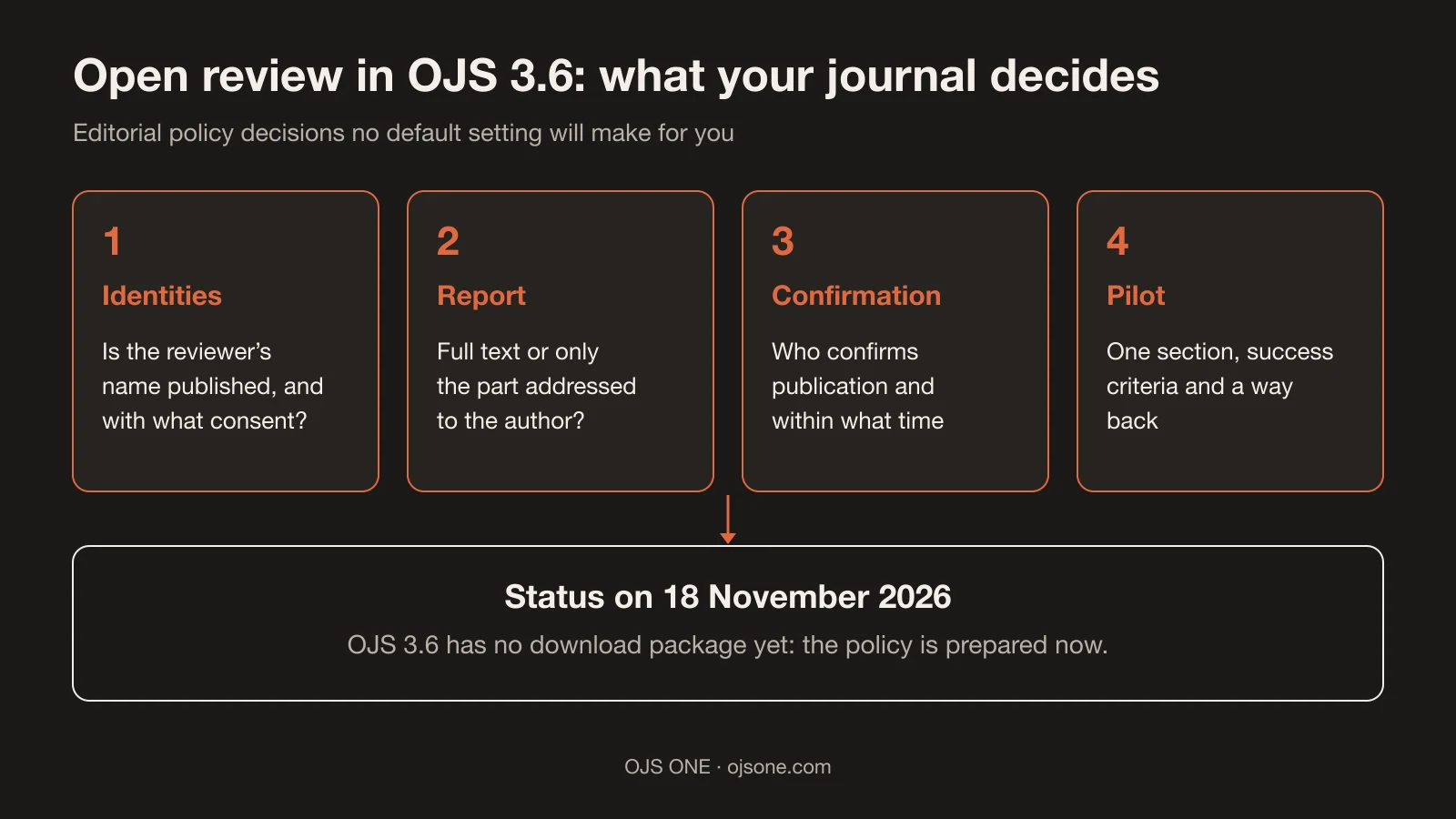
Direct answer: six editorial policy decisions that no default setting will make for you.
- Identities: is each reviewer's name published, or only the report? If it is published, with the reviewer's written consent recorded in the process?
- Report content: the full text, or the part addressed to the author? PKP distinguishes the portion the editor can edit before publishing1: decide who filters what.
- Publication timing: only after the editor's confirmation1. Define who confirms, within what time and with which criterion.
- Conversation: are reader comments and author responses enabled? That requires moderation with a named owner and publication rules.
- Promise to reviewers: PKP is studying exactly this with editors ("what it would mean for a workflow they maintain themselves, for a reviewer pool they recruit personally"2). If your committee is small, openness may cost you reviewers; that is discussed beforehand, not afterwards.
- Pilot scope: start with one section or one issue, with defined success criteria (decision time, number of reports accepted, incidents) and the ability to go back.
An own criterion, without data to back it yet: document the policy before enabling anything. The decision that is written down is the one that holds when the first public disagreement arrives.
How to prepare your committee in the meantime
Direct answer: six steps you can take this week, without installing anything.
- Put the topic on the next committee agenda with this piece and PKP's call as a basis; record positions for, against and with reservations (reservations are as useful as enthusiasm2).
- Ask your active reviewers whether they would sign their reports: your committee's real answer is worth more than any published average.
- Draft a policy with the six decisions from the previous section, written in language an author can understand.
- Define the pilot: number of articles, duration, who moderates comments and what you would do if a reviewer refuses to have their report published.
- Adjust your current workflow: the reviewer invitation and evaluation criteria can already be customized today (how to customize review recommendations).
- Review date: come back to the topic when 3.6 publishes its official package, with the draft ready to compare against what the tool actually offers.
What open review does NOT solve
- It does not, by itself, improve the scientific quality of decisions: that is the job of the editorial process, open or closed.
- It does not eliminate the traditional model: "open peer review is an option, and traditional peer review remains available"4; no journal is obliged.
- It does not replace your current workflow tools: customizing reviewer invitations and stage criteria remains yours (we cover it in customizing review recommendations).
- It does not guarantee visibility or citations: publishing reports changes transparency, not ranking.
Common mistakes when approaching openness
- Treating it as a technical switch and going off to look for the plugin: policy first, then the checkbox.
- Announcing the change to the community before having moderation rules and consents.
- Mixing open reports with open identities: they are independent decisions that require different agreements12.
- Copying another journal's model without considering the size of your committee, your real moderation capacity and the institutional backing you would have if the conversation turns difficult.
- Waiting for 3.6 to come out before starting the conversation: PKP warns that "No single set of tools covers the whole Open Peer Review concept"2; policy preparation does not depend on the version.
Frequently asked questions
Can I already enable open peer review in my OJS?
No. The features are part of 3.6, which as of 18 November 2026 has no download package3. What you can do today is write the policy and try it in a pilot with your current process.
Are reports published without asking the reviewer?
The workflow PKP describes publishes reports after the editor's confirmation1, but consent and identity rules are the journal's responsibility. Nothing in the tool replaces that agreement.
Does it replace the traditional review model?
No: PKP presents it as an option, and the traditional model "remains available"4. Each journal chooses according to its community, and PKP's study with editors aims precisely to understand that decision before consolidating it2.
Conclusion. Open review will arrive as an option in 3.6; the conversation about your policy costs nothing and should happen this quarter. If you want to review your current evaluation workflow and put the criterion in writing before the tool appears, the OJS 360 Assessment includes that dimension; you can also write to us.
Sources
- PKP. OJS, OMP, and OPS 3.6 in a Nutshell. https://pkp.sfu.ca/2026/11/17/ojs-omp-and-ops-3-6-in-a-nutshell/ (accessed 18 November 2026).
- PKP. Call for participants: a study on Open Peer Review in OJS 3.6. https://pkp.sfu.ca/2026/10/05/call-for-participants-opr-study/ (accessed 18 November 2026).
- PKP. Download and Install OJS. https://pkp.sfu.ca/software/ojs/download/ (accessed 18 November 2026).
- PKP. The New Open Research Europe Platform Is Live, Built on Open Journal Systems. https://pkp.sfu.ca/2026/11/03/new-open-research-europe-platform-is-live-built-on-ojs/ (accessed 18 November 2026).
OJS 360 Assessment
Before applying, know exactly what is missing
We review metadata, DOIs, OAI-PMH, policies and preservation against what DOAJ, Latindex and SciELO ask for, and hand you a prioritized route with owners.
- Evidence-based diagnosis by dimension
- Prioritized route and correction plan
- Indexing decisions always belong to the index
OJS 360 Assessment
Before applying, know exactly what is missing
We review metadata, DOIs, OAI-PMH, policies and preservation against what DOAJ, Latindex and SciELO ask for, and hand you a prioritized route with owners.
Request a diagnosis