We tested OJS 3.6: can it handle professional editorial production?
OJS 3.6 promises to turn a manuscript into HTML, PDF and JATS files inside the platform. We installed a development build and tested the complete workflow with one article. Our conclusion: the feature is worth following, but there is not yet evidence to replace professional editorial production with it or promise that it will reduce editors’ work.
What this means for your journal: the OJS 3.6.0.0 build we tested did not deliver structured JATS XML ready for SciELO or Redalyc. It does not replace XML tagging specialists or professional editorial production. If your journal needs to meet indexing requirements today, it needs a specialized workflow for markup, validation and quality control.
PKP has presented OJS 3.6 production tools around an appealing idea: upload a DOCX, edit its content in the platform and generate publication formats from a common source. This is a meaningful direction. But generating files and producing articles ready for publication, preservation and distribution are different tasks. The latter requires much more than an export button.
We tested what the available build does, what it delivers and what would need to improve before recommending it as a production solution for journals with demanding editorial and indexing requirements.
If your journal needs that production today, Jatson offers structured JATS XML for destinations such as SciELO and Redalyc, enriched editorial HTML and a typeset PDF, with validation and editorial control under the agreed scope.
The promise: from manuscript to publication formats
PKP says the planned workflow converts a DOCX body to editable HTML using Pandoc, integrates a text editor and can produce HTML, PDF and JATS XML galleys. It also describes metadata extraction and structured citation tools, depending on configuration and available plugins.1
The promise is not a professional production solution. Our test produced basic files but did not establish professional galleys or structured XML ready for indexing destinations. The journal still needs editing, markup, typesetting and quality control. Future improvements must demonstrate whether they reduce that work.
OJS 3.6 is an STS, not an LTS: implications for institutional portals
OJS 3.6 belongs to a short-term support (STS) branch, not a long-term support (LTS) release. Under PKP’s policy, even-numbered branches, including 3.6, are STS; odd-numbered branches such as 3.5 become LTS. LTS releases are intended for installations that need a longer maintenance window and cannot upgrade as frequently.4
For institutional portals that prioritize stability and continuity, we do not recommend OJS 3.6 as the production baseline. In a portal hosting multiple journals, each upgrade requires planning and testing plugins, themes, integrations and editorial workflows. An STS branch means preparing the next upgrade sooner. Shorter support does not mean an absence of patches while the release is supported; it means a different maintenance horizon.
We recommend that institutions plan around a supported LTS release, such as OJS 3.5 LTS, keep it updated and test migrations before production. OJS 3.6 can be evaluated in a test environment; its announced production features alone are not a sufficient reason to migrate an institutional portal.
What we installed and tested
On November 15, 2026, we installed a development main branch build identified as OJS 3.6.0.0, at commit 925ed49 dated November 14. Our test environment used PHP 8.3 and MariaDB 10.11. This is not an assessment of a final release: the code can change and a later build may behave differently.
We created a journal and a test submission. The DOCX contained a title, abstract, three sections and two references. We accepted the submission, moved it to copyediting and used “Send to Text Editor”. We then examined the imported content, generated an HTML galley, created a PDF galley and downloaded the XML available in the JATS section.
The sample was simple. We did not test complex tables, equations, images, multiple languages, successive corrections, upgrades from an existing installation or a real delivery to an index or collection. Nor did we time the work against an existing professional process. This test shows what happened in one installation; it cannot quantify savings or evaluate every announced feature.
HTML and PDF: files are generated, but production is not finished
The DOCX was converted and its text became available in the editor. The HTML galley displayed the test article’s body. We also obtained a preview and the system confirmed that it had saved a PDF galley.
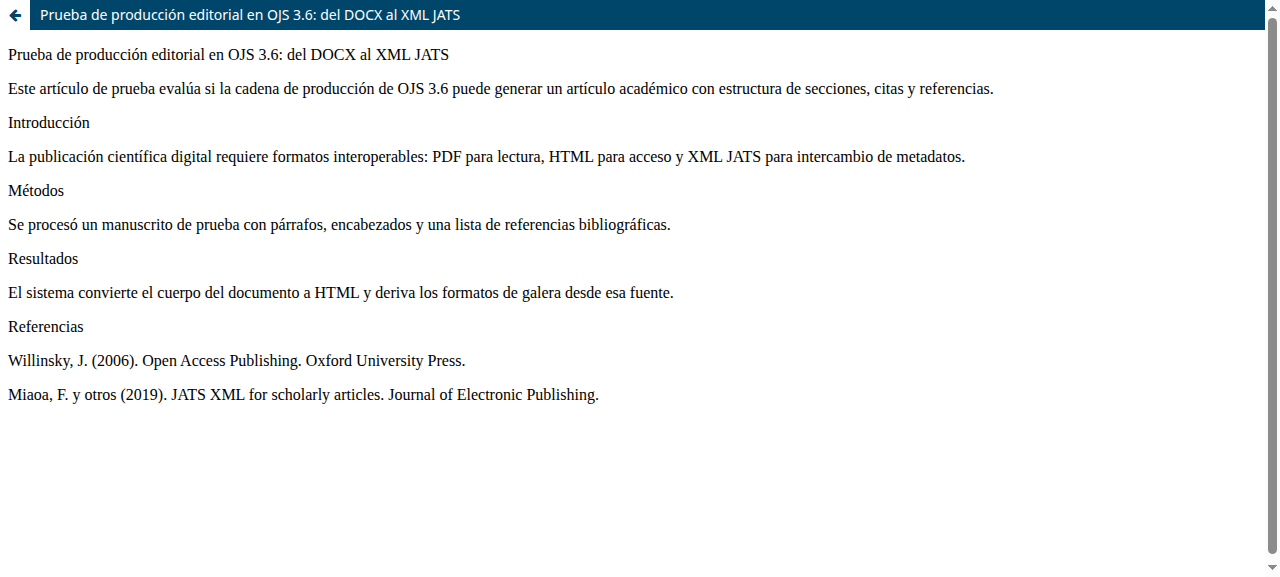
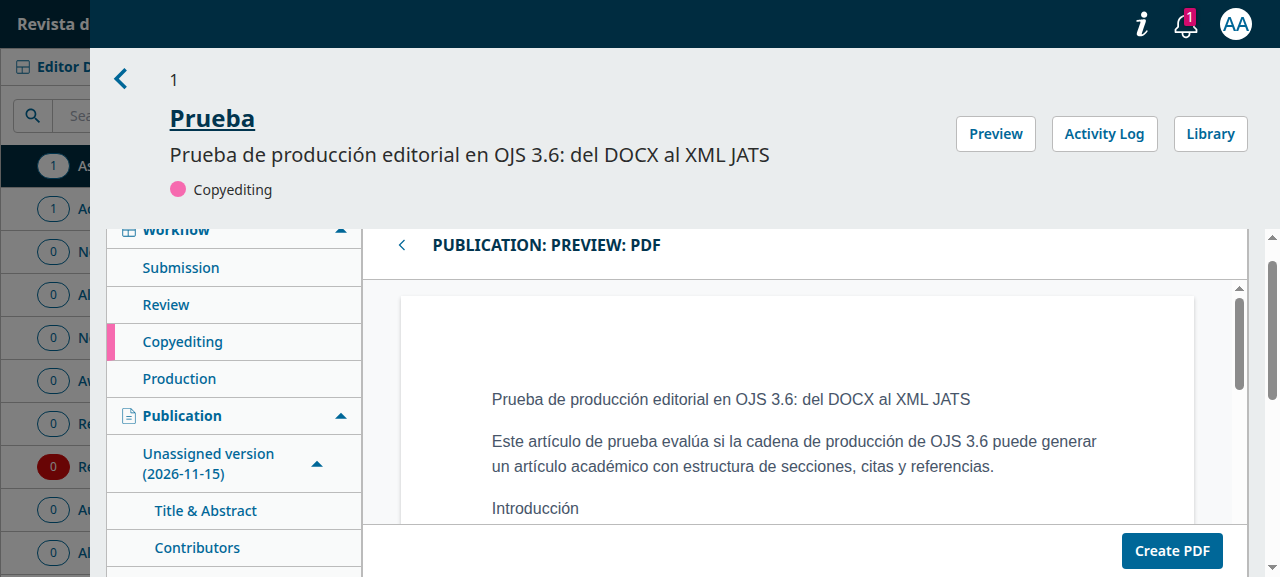
This establishes that the basic workflow operated for this example. It does not establish that the result meets a journal’s needs: structure, design, readability, citations, links, images, tables, accessibility and consistency across formats still require review. A created galley is not automatically ready to publish.
We did not test PKP’s described preservation of tables and equations with complex documents. Those capabilities need to be tested with real articles of varying difficulty before drawing conclusions.
The XML: what we observed and what it means
We downloaded the XML offered by the installation. It declared JATS 1.2 and was well-formed XML. In that specific output, however, the body appeared as escaped HTML inside a single paragraph; we did not observe a section structure or a reference list marked up as JATS elements. The DOCX references appeared as text and the references panel displayed “No references yet”.
This describes the file and configuration we tested, not every possible path or the final release. In particular, the test cannot establish how much the result might change with structured citations configured, other metadata completed or a future build. These are pending tests, not questions we can treat as settled.
JATS is a standard; SciELO Publishing Schema is a profile with its own versions and rules. A file declaring JATS 1.2 does not thereby declare SPS 1.2. It would be misleading to present validation against a SciELO schema chosen for another purpose as proof of a defect in output that was not presented as conforming to that profile.2
For a journal with indexing requirements, the relevant question is whether the output has the structure, metadata and rules required by its destination and can be validated and delivered repeatably. Our test does not establish that yet.
Does it reduce editors’ work?
For now, our test does not show that it does. We did not conduct a timed comparison and the file was simple. What we saw is that generating outputs does not eliminate text review, metadata preparation, reference work or file checks. Where XML needs additional structure, that work must also be done and verified somewhere.
A future improvement could save specific tasks: preserving manuscript structure, linking references, avoiding duplicate corrections across formats or generating outputs ready for final review. That promise must be measured with representative articles and compared against the whole previous workflow, including error correction.
What professional production requires
A journal needs more than files. It needs a chain that turns an accepted manuscript into consistent, checked publications: copyediting, treatment of tables and figures, composition, complete metadata, references, identifiers, markup, quality control and compliance with each destination’s requirements. It also needs assigned responsibilities, timelines and a way to correct a published version.
This tested build is far from replacing that chain. Future versions will need to demonstrate whether they can help with any of its stages. For journals with indexing commitments, assuming that a future release will solve production on its own can delay a decision they need to make today.
What to check in future releases
We will follow OJS 3.6 with specific questions:
- Does the DOCX retain sections, tables, equations, images and references in a useful structure?
- Can editors correct content and metadata without repeating changes across formats?
- Does the generated XML represent the complete article in the structure required by its destination?
- Do HTML and PDF galleys meet the journal’s design, reading and accessibility needs?
- How long does producing and checking a set of real articles take compared with the current process?
- Which tasks still require external tools or specialists?
The comparison needs an exact version, documented configuration and each journal’s acceptance criteria. A demonstration with a simple manuscript is a starting point, not a production guarantee.
The decision for a journal today
If an existing professional workflow delivers and validates the required formats, there is no reason to replace it with a promise. If you need editorial production now, define the scope, destinations and controls you require, then assess providers or tools that can demonstrate them. OJS 3.6 deserves continued observation and testing; future releases will need to show how much they help and how much work they actually save.
OJS 3.6 and Jatson: a production comparison
| Production need | OJS 3.6: promise and current test | Jatson: professional production |
|---|---|---|
| Convert the manuscript | Yes, in our test: a simple DOCX entered the editor. PKP announces an integrated workflow. | Yes: processing of the accepted manuscript for editorial production. |
| HTML | Yes, basic: the test galley displayed text; enriched editorial HTML with metadata and linked data was not demonstrated. | Yes: editorial HTML with enriched metadata and linked data, with quality control. |
| Yes, basic: a test galley was generated; it is not a professionally typeset editorial PDF. | Yes: professionally typeset editorial PDF with quality control. | |
| Structured JATS XML | No, in our test: the body was escaped HTML; we observed no structured JATS sections or references. | Yes: structured JATS XML with enriched metadata and quality control. |
| XML for SciELO | Not established: the test did not produce or demonstrate XML conforming to SciELO requirements. | Yes: XML production and validation for SciELO under the agreed scope and requirements. |
| XML for Redalyc | Not established: we did not test or demonstrate output conforming to Redalyc. | Yes: XML production and validation for Redalyc under the agreed scope and requirements. |
| Editorial quality control | Still required: generating files does not replace editorial review. | Yes: the service includes editorial quality control and technical validation. |
| Complement OJS | Features integrated into the development build. | Yes: complements an existing OJS installation without replacing peer review. |
The OJS column describes a development build and a test with one simple article; it does not predict future releases. Jatson’s scope and destination requirements are agreed for each journal. No tool guarantees acceptance or indexing on its own.
Jatson: professional production without waiting for OJS 3.6
If your journal needs to produce articles for publication and indexing today, OJS ONE Jatson is our professional editorial production engine. Starting with the accepted manuscript, our team uses Jatson to prepare a typeset PDF, reading HTML, EPUB and JATS XML, with technical validation and editorial quality control based on the requirements agreed for the journal and its destinations.
Jatson complements OJS: you do not need to change your platform or peer-review workflow. Production can be commissioned per article or by volume without purchasing OJS hosting or administration. If your journal needs XML for SciELO, Redalyc or another destination, we review the scope and applicable specifications with you; producing files alone does not guarantee acceptance or indexing.
Discover Jatson and request an assessment of your editorial production.
Sources
- PKP. Upload, Transform, Publish: Inside OJS 3.6’s File Production and Toolset. https://pkp.sfu.ca/2026/07/21/inside-ojs-3-6-file-production-and-toolset/
- SciELO. The
<article>element and SciELO Publishing Schemaspecific-useattribute. https://docs.scielo.org/projects/scielo-publishing-schema/pt-br/latest/tagset/elemento-article.html - PKP. Download and Install OJS. https://pkp.sfu.ca/software/ojs/download/
- PKP. PKP Software Releases. https://pkp.sfu.ca/software/releases
Jatson · editorial production
From the accepted Word file to validated PDF, HTML and JATS XML
Jatson produces all three formats from the accepted article and delivers the validation report for every submission. Your team stops tagging by hand.
- XML compliant with SciELO's SPS
- HTML ready to read on the article page
- Ready to load into OJS
Jatson · editorial production
From the accepted Word file to validated PDF, HTML and JATS XML
Jatson produces all three formats from the accepted article and delivers the validation report for every submission. Your team stops tagging by hand.
Discover Jatson