SciELO Publishing Schema 1.10 is the successor to version 1.9 of SciELO's tagging guidance. The version required for a particular submission depends on the collection and its validation process. Confirm the applicable version and timetable with your collection before changing production.12
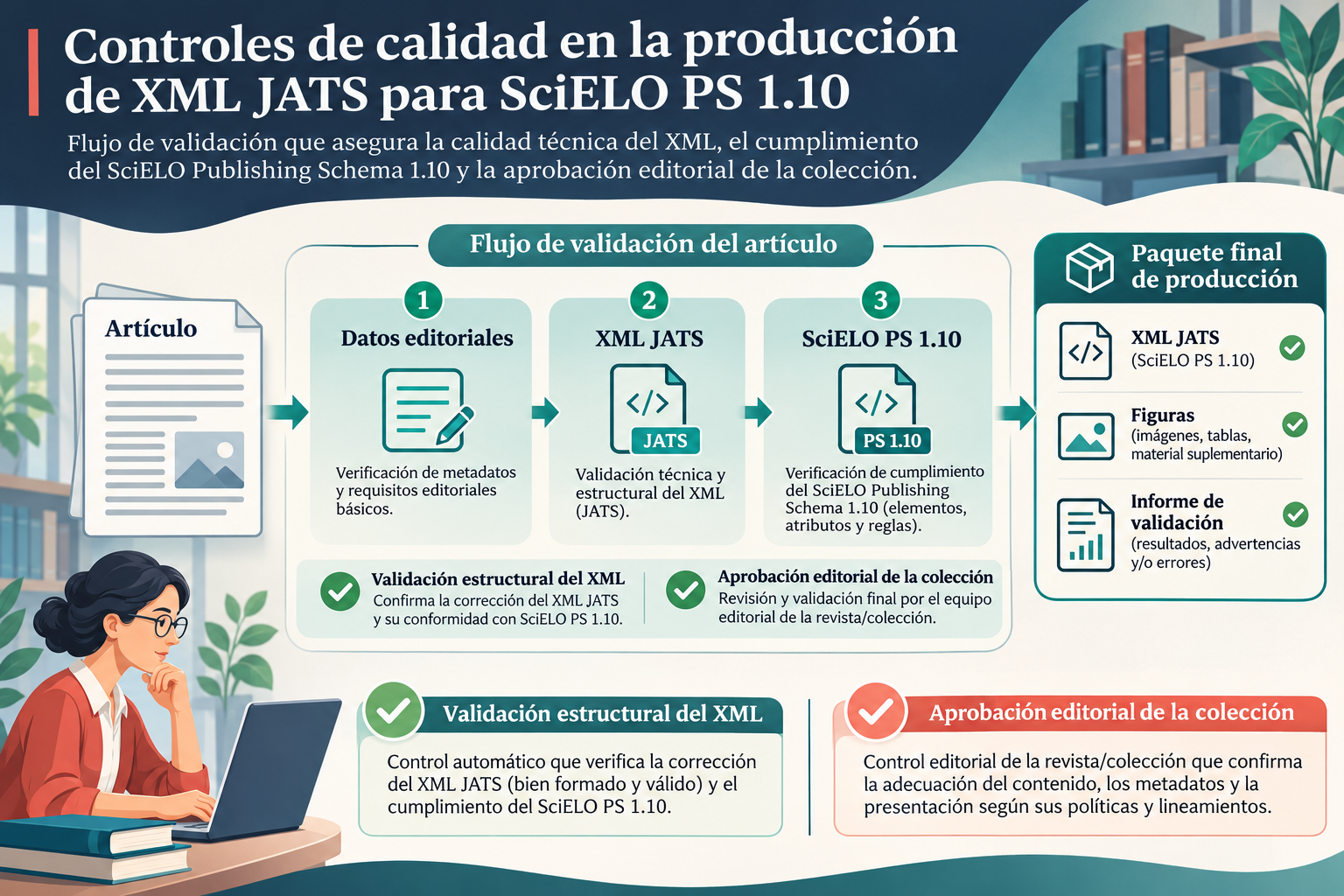
JATS validity and SciELO requirements
SciELO Publishing Schema applies the NISO JATS Journal Publishing DTD together with SciELO's own specialized rules.3 A structurally valid JATS file is therefore not automatically compliant with a collection's SciELO requirements. Check the XML structure, the applicable SciELO profile and the editorial accuracy of the article as separate steps.
SciELO released the 1.10 documentation in advance so editorial teams and XML service providers could prepare their processes for the associated tools.2 Historical transition announcements are useful context, but they should not be treated as the current deadline for every collection.
Changes to review
SciELO's change documentation describes the following updates from 1.9:1
- An ORCID identifier is required for at least one author of the document.
- The CRediT taxonomy is incorporated for contributor roles.
- Documentation covers the markup of open peer-review reports.
- A key-points abstract type and video in graphical abstracts are addressed.
- The
addendumarticle type is added and contributor-type restrictions are revised.
Consult the official change list for element-level details. A collection may apply additional rules or have its own adoption schedule.
Ask the collection before changing versions
Obtain written answers to five questions: which SPS version is required now; the effective date and any transition period; which validator is accepted; whether the collection applies additional rules; and whether previously published material must be retagged. Keep the response with the issue's production records.
Do not assume a provider can choose the profile independently. Agree on the version and deliverables with the collection and the publisher before starting markup.
Prepare editorial data
Capture author identifiers during submission instead of waiting until XML production. Define how contributor roles are requested and reviewed if the journal publishes CRediT statements. If articles include key points, graphical abstracts or supplementary files, confirm what the collection accepts and how each item should be represented.
Review an existing sample before reworking a backlog. Record the SPS version, validator and date, ORCID availability, contributor roles, abstract types and agreement between XML, PDF and HTML. Classify each issue as a source-data problem, a markup problem or a collection-specific rule so the right person can resolve it.
Move in stages
If the collection confirms adoption of 1.10, begin with a diagnostic sample. Adjust submission forms and author instructions, then produce and validate a pilot issue using the collection's accepted tools. Keep the XML, package, validation report and editorial decision together. Document the profile, validator version and collection rules before scaling the workflow.
Avoid switching versions without agreement, assuming yesterday's validation is sufficient for a changed file, or treating ORCID as a last-minute production task. A regenerated file needs its own validation evidence.
Jatson supports editorial production of PDF, HTML and JATS XML using an agreed target profile. The collection determines its own acceptance requirements; request the profile, validator and validation date from any production provider.
Jatson, OJS ONE's editorial production engine, produces PDF, HTML and JATS XML from the accepted article, validated against the profile agreed with each journal. Acceptance by SciELO or any collection is always the collection's decision; what you can ask of any provider is the SPS version, the validator used and the validation date in writing.
Frequently asked questions
Must published articles be retagged?
There is no universal answer. Ask the collection what applies to new issues and previously published content.
Is ORCID required for every author?
The documented 1.10 change requires it for at least one author; a collection may impose additional requirements.1
Where can technical questions be raised?
Consult the official SciELO documentation and its XML discussion list for the current implementation guidance.3
Sources
Jatson · editorial production
From the accepted Word file to validated PDF, HTML and JATS XML
Jatson produces all three formats from the accepted article and delivers the validation report for every submission. Your team stops tagging by hand.
- XML compliant with SciELO's SPS
- HTML ready to read on the article page
- Ready to load into OJS
Jatson · editorial production
From the accepted Word file to validated PDF, HTML and JATS XML
Jatson produces all three formats from the accepted article and delivers the validation report for every submission. Your team stops tagging by hand.
Discover Jatson