The OJS subscriptions vulnerability CVE-2026-111609 does not take a site down or alter articles: it lets a manager of one journal read and reassign subscriptions belonging to other journals on the same portal.1 It is an editorial cybersecurity matter because it forces directors to decide on permissions, evidence and owners. Here is the flaw explained and the list of decisions for this week.
What is the OJS subscriptions vulnerability CVE-2026-111609?
It is an access-control flaw (CWE-639) in the subscription management forms of OJS, published on 16 October 2026 with medium severity and a CVSS score of 5.1.1 When a manager asks to edit a subscription, OJS looks it up by its global numeric identifier without checking that it belongs to the journal the manager administers.4 Sending the number of someone else's subscription is enough for the form to load it and show its data.2
The code of the individual subscription form on branch 3_5_0-5 confirms this behavior: it calls getById($subscriptionId) without passing the journal identifier.5 The technical report of the discovery covers OJS 3.5.0-51 and notes that the same call pattern exists in forms of earlier 3.x branches.3
Who is affected: multi-journal portals and management roles
The crossover happens between journals sharing a single OJS installation, that is, institutional portals hosting several titles.2 In that context each journal has its own managers and subscription managers,7 and the permission check in force (ContextAccessPolicy) only verifies that the account has a role in the current journal, without tying the requested subscription to that journal.4
These are the situations with real exposure:
- A portal with several journals and the subscriptions module active, with more than one account holding a manager or subscription manager role.
- Management accounts shared across journals of the same institution: they widen the number of people who can reach the flaw.
- Journals with individual or institutional subscriptions loaded in OJS: their subscriber records are the data at stake.
If your journal runs alone on its installation, the crossover between journals has nowhere to happen; even so, it is worth reviewing who holds management permissions.2
What can someone exploiting it do (and what not)?
They can do two things, both with the manager role of one journal on the portal: enumerate identifiers to see the subscriber data of other journals, and reassign those subscriptions to their own journal, leaving the original subscriber without access.2 The score vector indicates confidentiality and integrity affected to a low degree and availability not affected; it requires a privileged account.6
What this flaw does not allow, according to the published information: running code, modifying articles, taking the site down or stealing passwords.1 Do not trivialize it, though: subscriber data is personal data, and its disclosure or improper reassignment has contractual and reputational consequences for each affected journal.
As of 6 November 2026 I found no public notice of a fixed OJS version in the sources consulted for this article; the development repository does not publish release notes with patches. Confirm the status with PKP or with whoever administers your installation before treating the matter as closed.
What the journal's leadership must decide
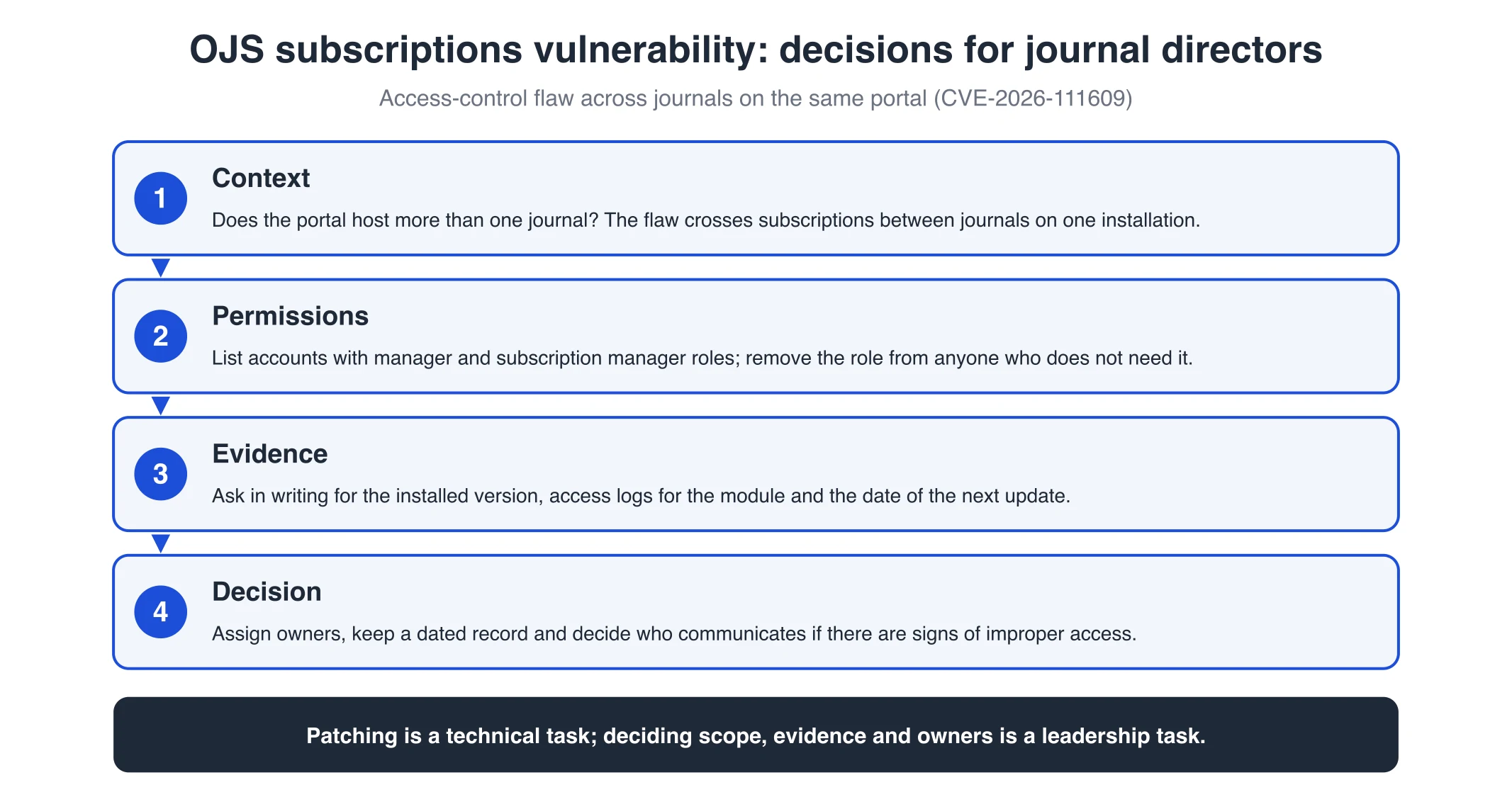
The short answer: leadership decides the scope of the problem, the evidence it demands and who responds; applying the patch is a technical task subordinate to those decisions. This is the list for the next leadership or editorial committee meeting:
- Confirm the context. Does your journal's installation host more than one journal? If yes, the flaw applies directly; if not, close this point and move on to the rest.
- Inventory permissions. Ask for the list of accounts with manager and subscription manager roles in each journal of the portal. Every account that does not need that role should lose it: this is the measure that reduces the flaw's surface until a fix arrives.
- Assess the subscriptions module. If no journal on the portal sells subscriptions through OJS, ask your team whether the module can be disabled; an absent component cannot be exploited. This is an operational decision, not an official requirement.
- Demand evidence, not promises. From your provider or IT team: the exact OJS version installed, the date and owner of the next update, and confirmation of whether access logs for the subscriptions module were reviewed. The same as we already explained for the PHP patch: installed is not the same as active, and patching today does not prove nobody got in before.
- Define owners and a record. On a multi-journal portal, who answers for an incident of this kind: the institution hosting the portal, the operations provider or each journal? Put it in writing with a date; undocumented decisions get lost exactly when they are needed.
- Decide on communication. If the review finds signs of improper access to subscriber records, decide who notifies those affected and with what verified information. Communicate nothing before confirming the scope: a hasty retraction costs more than a day of silence.
These decisions protect three assets a journal does not recover with a click: editorial continuity, the trust of subscribers and authors, and reputation with indexes and evaluators. That is why the topic belongs to editorial cybersecurity and not only to the IT team's backlog.
How to demand evidence from your provider or IT team
The short answer: ask in writing for three pieces — scope, evidence of execution and a follow-up plan — and file the reply together with the decision record. A minimal checklist:
- OJS version declared and verified on the installation (not the one in an old inventory).
- Confirmation of whether the subscriptions module is active in each journal of the portal and how many accounts hold management permissions.
- Result of the review of access logs to the subscription screens, with the period reviewed and the tools used.
- Date, owner and window of the next OJS update, with a rollback plan.
- Closing criterion: who signs that the risk was addressed and with what evidence attached.
If whoever administers your installation cannot deliver those five pieces, the problem is not the CVE: it is that nobody has documented control of the platform. Our articles on what to demand from your provider after the PHP patch and on hardening after an incident expand that procedure.
Common mistakes when reacting
- Confusing this flaw with the October PHP vulnerabilities. They are different layers: that patch is applied on the server and this one is an access flaw in OJS.1 Patching PHP does not close CVE-2026-111609, and updating OJS does not rule out that someone got in earlier through PHP.
- Updating and treating earlier compromise as ruled out. These are two separate questions: "is it fixed?" and "did anyone get in before?". You need an answer to both, with logs.
- Changing configurations before preserving evidence. If you suspect improper access, save logs and copies before intervening; recovering a journal after an intrusion starts by preserving evidence.
- Leaving the decision hanging between the journal and the institution. On multi-journal portals, confusion over owners is the real failure that later multiplies the damage.
- Communicating without verifying. Notifying subscribers on assumptions creates alarm and discredit; first confirm the scope with evidence.
Frequently asked questions
Should I stop using subscriptions in OJS because of this flaw? Not necessarily. The flaw requires a management account and a portal with several journals.2 If you sell subscriptions through OJS, reduce permissions and wait for the fix; if you do not use them, assess disabling the module with your team.
My journal runs alone on its installation. Am I exposed? The crossover in this CVE happens between journals on the same installation, so with a single journal the scenario does not apply.7 Even so, review how many accounts hold management permissions: it is good practice regardless of the flaw.
They already applied the October PHP patch on my server. Is that enough? No. That patch fixes the PHP interpreter; this is an access-control flaw inside OJS.1 They are accumulated pending items and are best handled in a single security review, with evidence for each one.
Conclusion. The OJS subscriptions vulnerability is managed through leadership decisions: scope, permissions, evidence and owners in writing. At OJS ONE we support that process from editorial cybersecurity: preventive audits, compromise assessment and incident response for journals running OJS, with one team that knows both the platform and the editorial workflow. If you want to review the state of your installation, write to us from the OJS ONE cybersecurity page.
Sources
- VulnCheck, "PKP Open Journal Systems through 3.5.0-5 Cross-Journal Subscription IDOR via updateSubscription" — https://www.vulncheck.com/advisories/pkp-open-journal-systems-through-3.5.0-5-cross-journal-subscription-idor-via-updatesubscription (accessed 6 November 2026)
- VulnCheck, advisory description CVE-2026-111609 — https://www.vulncheck.com/advisories/pkp-open-journal-systems-through-3.5.0-5-cross-journal-subscription-idor-via-updatesubscription (accessed 6 November 2026)
- hieuPenguinnn, "Open Journal Systems cross-journal subscription disclosure and reassignment through unscoped subscription forms" — https://hackmd.io/@hieuPenguinnn/ojs-subscription-form-cross-journal-idor (accessed 6 November 2026)
- hieuPenguinnn, "…unscoped subscription forms", Summary and Root cause sections — https://hackmd.io/@hieuPenguinnn/ojs-subscription-form-cross-journal-idor (accessed 6 November 2026)
- PKP, OJS 3.5.0-5 code,
IndividualSubscriptionForm.php— https://github.com/pkp/ojs/blob/3_5_0-5/controllers/grid/subscriptions/IndividualSubscriptionForm.php (accessed 6 November 2026) - VulnCheck, CVSS v4.0 vector of advisory CVE-2026-111609 — https://www.vulncheck.com/advisories/pkp-open-journal-systems-through-3.5.0-5-cross-journal-subscription-idor-via-updatesubscription (accessed 6 November 2026)
- hieuPenguinnn, "…unscoped subscription forms", Summary — https://hackmd.io/@hieuPenguinnn/ojs-subscription-form-cross-journal-idor (accessed 6 November 2026)
Cybersecurity for OJS
Is your OJS patched and free of prior compromise?
We audit the installation, apply OJS and PHP patches with evidence, hunt for webshells and persistence, and respond if an incident has already happened.
- OJS-specific audit and hardening
- Patches with a tested restore
- Incident response
Cybersecurity for OJS
Is your OJS patched and free of prior compromise?
We audit the installation, apply OJS and PHP patches with evidence, hunt for webshells and persistence, and respond if an incident has already happened.
Review my OJS