
OJS Intrusion: Decisions to Recover a Journal
Anonymized OJS intrusion case: which decisions to make to contain, investigate, migrate and recover a journal's editorial operation with evidence.
OJS Intrusion: Decisions to Recover a Journal
An OJS intrusion is not just an infrastructure problem. It can interrupt the editorial workflow, cast doubt on the integrity of files and metadata, and force a journal to explain what is happening to authors, reviewers and readers.
This real case was anonymized to protect the affected journal. It does not aim to describe a reproducible attack: it shows which signals changed the decision from an apparent clean-up to a recovery with evidence, controls and clear owners.
The OJS intrusion was a chain, not a single failure
The evidence showed a sequence of abuse that crossed registration, profiles, file uploads, privileges and persistence. It was not reasonable to attribute it to a single weakness or to treat each signal as an isolated problem.
The visible starting point was open registration receiving disposable accounts. Some of those accounts left non-editorial content in profiles; others included active content designed to affect whoever viewed it. Later, uploads that did not belong to the editorial workflow appeared, aimed at checking whether the server would execute what a user uploaded.
Privileges were also found that the ordinary interface does not allow granting in that context. That difference mattered more than the number of accounts: it indicated that someone had modified authorization data outside the intended workflow. Further on, components that imitated legitimate elements surfaced, along with files hidden among seemingly harmless resources.
The lesson for a journal's leadership is not to learn the attacker's techniques. It is to recognize that an anomalous account, an improper upload, an unexpected privilege or an unauthorized component may belong to the same chain. In that scenario, putting the site back online does not prove that the operation is trustworthy.
Separating files kept the situation from escalating immediately
The barrier that limited the initial damage was simple: submission files were outside the area reachable from the web. Although improper uploads were accepted, the server could not execute them through a web visit. OWASP recommends keeping uploaded files outside the web root when they cannot be separated onto another server.[1]
That measure does not replace the others. Allowing only necessary extensions, verifying the real file type, assigning controlled names and limiting who can upload are complementary controls.[1] The OJS configuration template also states that the directory for uploaded files must not be directly accessible from the web.[2]
For whoever runs the journal, this translates into an operational decision: confirm where manuscripts, galleys and private files live, who can write there and which component can serve them. It is not enough to assume that the provider or the technical team has already settled that boundary.
The available evidence defines how far you can claim
An honest investigation must distinguish findings, hypotheses and gaps. In this case there were enough indications of unauthorized modification and persistence. It was not possible to confirm the first access because the available logs covered too short a period relative to when the relevant activity took place.
For that reason, some possibilities remained hypotheses rather than a closed explanation: weak or reused credentials, an additional application with unsafe queries, or unpatched software. OWASP warns that concatenating user-supplied text into dynamic queries is a cause of injection and recommends eliminating that pattern.[5] That guide explains why an additional application deserves review; it does not prove it was the route used in this case.
Logs must make it possible to reconstruct actions, review changes and relate events. OWASP describes audit logs as a chronological sequence that allows reconstruction and review.[3] If retention is short or there is no independent copy, the team loses context exactly when it needs it most.
The right decision is to record what is not known, preserve the available evidence and act according to the level of uncertainty. If there are accounts with unexplained privileges, altered files or potentially exposed credentials, it is wise to treat the integrity of the environment as an open question until a review resolves it.
Leadership must decide on continuity, not only on technical tasks
An OJS intrusion demands editorial and governance decisions. The editor-in-chief does not need to carry out the review, but must define who can stop changes, who preserves evidence, who authorizes a recovery and how an interruption is communicated.
It is worth putting these decisions in writing before an incident:
- Owner of updates for OJS, the operating system, the runtime environment and additional components. PKP's security policy distinguishes supported versions from versions that no longer receive support; reviewing that status is part of maintenance, not an exceptional reaction.[7]
- Protection of registration and submissions. Open registration requires controls against automation and a review of accounts that receive sensitive permissions. OWASP lists CAPTCHA among the defenses against automated attacks.[4]
- Periodic role review. Each administrative privilege must have a reason, a responsible person and a procedure to withdraw access that no longer applies.
- Separation of applications. An additional form or development must not inherit, without review, access to the database, private files or OJS credentials.
- Secrets management. Keys must be different for each component, limited by permission and renewed after a well-founded suspicion. OWASP recommends fine-grained access controls for the system that manages secrets.[6]
- Log retention. Define which events are recorded, where they are kept and who can consult them without altering the evidence.
These measures are not a checklist to tick and forget. They must be assigned to a person, reviewed after relevant changes and tested in everyday editorial operation.
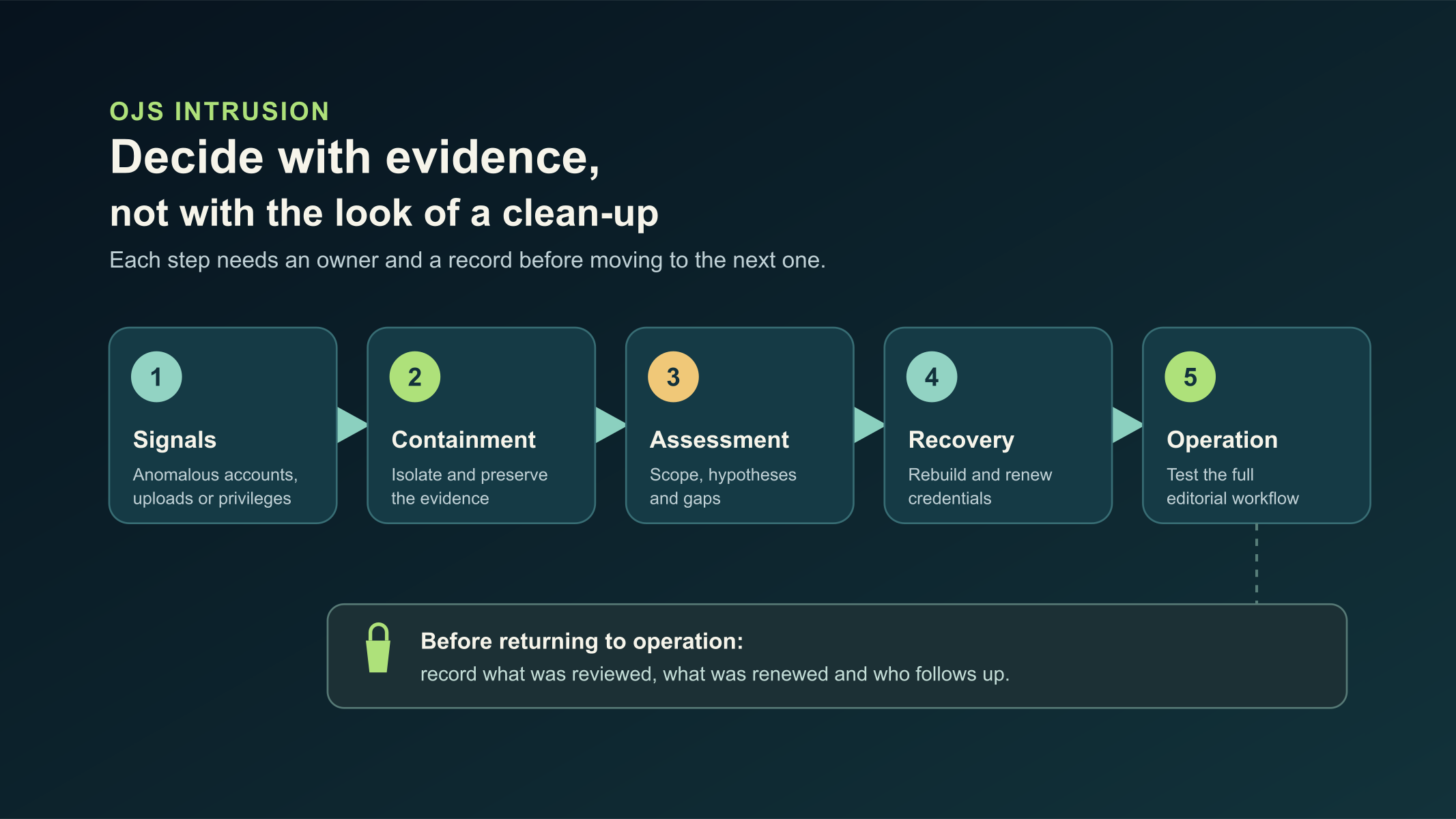
Original diagram. It shows the decision sequence; it does not represent the infrastructure or the evidence of the affected journal.
When migrating, do not carry the doubt into the new environment
When there is evidence of compromise, a migration is not a matter of copying a database and a files folder to another server. That move can carry over improper accounts, altered resources, exposed configurations or persistence mechanisms that have not yet been identified.
The leadership question is which information can be shown to be necessary and reviewed in order to rebuild the operation. The material to migrate must go through an audit of accounts, roles, files, extensions, components and configuration. Related credentials must be renewed; changing only the visible password of one account is not enough.
The editorial workflow must also be tested after recovery: registration, login, submission, review, editing and publication. Continuity is not demonstrated when a home page loads, but when the legitimate process can work without retaining elements nobody understands.
If the journal does not have enough evidence to trust the environment, it should consider a rebuild from known sources and a selective migration. It is a more demanding decision than a superficial clean-up, but it avoids confusing momentary availability with recovery.
Common mistakes after an incident
The most frequent mistake is deleting the visible signal and considering the case closed. These shortcuts leave questions unresolved:
- Restoring service without first isolating the suspicious activity or preserving evidence.
- Keeping users and privileges because the journal needs to keep operating, without reviewing how they were created.
- Moving files and database to a new environment without a prior review.
- Changing a single key when several applications shared credentials or could read the same configuration.
- Interpreting the absence of logs as the absence of malicious activity.
- Turning a technical hypothesis into public attribution or certainty.
- Publishing lengthy explanations before knowing which information is verifiable and which data must be protected.
Avoiding these mistakes protects both the investigation and the journal's reputation. A sober communication can report an interruption and the safeguarding measures without exposing details that could facilitate new abuse or identify affected people.
To go deeper into the difference between noise, attempt and sign of compromise, read the guide on early signs of compromise in OJS. If there is already evidence of alteration, the guide on hardening and rebuilding after an incident explains the containment and recovery sequence without treating a clean-up as proof of integrity.
Frequently asked questions
Should a journal assume compromise because a suspicious file appeared?
Not necessarily. An isolated finding may require analysis before it is classified. But if it is combined with unexplained privileges, code changes, anomalous accounts or activity outside the editorial workflow, the prudent decision is to contain, preserve evidence and widen the review.
Can you recover without halting the entire editorial operation?
It depends on the scope and on the confidence you have in the environment. Before keeping exposed functions running, define which process is isolated, how evidence is preserved and what information authors and reviewers need. The priority is not to widen the damage or alter the elements that would allow it to be understood.
Does a lack of logs prove that nothing happened?
No. It shows a limit of observation. Without sufficient logs, the absence of activity cannot be confirmed; that is why retention, an external copy and the review of roles and files are important preventive decisions.[3]
Recovery needs a responsible, traceable decision
The way out of an incident is not a screenshot of the site working. It is a documented decision about what was reviewed, what was renewed, what was excluded from the migration and who takes on the follow-up.
OJS ONE offers incident response, compromise assessment and hardening for OJS environments.[8] The service may be relevant when a journal needs to organize evidence, define scope and prepare a technical recovery without mistaking it for a promise of zero risk.
Sources
- OWASP, File Upload Cheat Sheet — accessed 2026-10-23.
- PKP, OJS configuration template — accessed 2026-10-23.
- OWASP, Logging Cheat Sheet — accessed 2026-10-23.
- OWASP, Authentication Cheat Sheet — accessed 2026-10-23.
- OWASP, SQL Injection Prevention Cheat Sheet — accessed 2026-10-23.
- OWASP, Secrets Management Cheat Sheet — accessed 2026-10-23.
- PKP, Security Policy — accessed 2026-10-23.
- OJS ONE, Cybersecurity and Editorial Continuity for OJS — accessed 2026-10-23.
Is your journal struggling with slow performance or recurrent outages?
Contact our team and see how enterprise-grade infrastructure can transform your editorial operation.
Request assessment