
Outsourcing JATS XML Tagging for SciELO: How to Decide
Decide whether to outsource JATS XML tagging for SciELO: compare an in-house team, tools and a full service with clear deliverables.
Outsourcing JATS XML Tagging for SciELO: How to Decide
To decide whether to outsource JATS XML tagging, compare who will do the work, who will resolve corrections and who will keep the files available. You can produce in-house, use a tool with institutional work, or hire a full service. We recommend choosing after testing a representative sample and agreeing on responsibilities in writing.
Outsourcing JATS XML tagging: decide based on real capacity
Keep production inside the institution if you can assign owners, training and continuity. Consider a service if you need to delegate execution, but keep an editorial counterpart who can approve the result. This is our management recommendation, not a SciELO requirement.
Before requesting quotes, review the calendar and the tasks your team already carries. Note who can produce during closing periods, who replaces them and what happens when corrections arrive after proofs are approved. A person who knows XML but has no assigned time is not a stable production capacity.
Do not compare a license with a finished delivery either. One proposal may sell you access; another, production work. Require both to state what your journal must do to reach the same final package. Only then will you have comparable scopes.
Compare editorial production models for SciELO
The models differ in how the work is distributed, not in the name of the program. Use them as categories for reviewing proposals: the same company may offer more than one option.
| Model | Who executes | What the institution keeps | Profile we recommend evaluating it for |
|---|---|---|---|
| In-house team | Institutional staff produce and correct with the chosen tools | Operation, approval and maintenance of the workflow | A portal with assigned time and backup between people |
| Tool with institutional work | Your team tags or reviews inside an external application | Editorial execution, training and technical acceptance | A journal with an available operator looking for software support |
| Full service | A provider carries out the production included in the contract | Editorial decisions, approval and oversight | A team that wants to delegate production without hiring an internal operator |
The distinction has public examples. JATS Studio separates the use of the application, where the client does the tagging, from the service in which its team prepares the files. That description documents the options offered; it does not demonstrate results for your journal.[1]
There are also institutional developments and open projects. The SciELO MarkAPI repository describes a workflow toward SPS XML with possible human review.[2] Its existence does not prove that you can install, maintain and operate it without support. If you evaluate open-source software, include those tasks in your decision.
A service called "full" does not necessarily include loading into OJS, maintaining the viewer or later corrections either. Ask the proposal to name each activity.
Define the target before choosing JATS XML tagging tools
Specify the technical delivery profile and confirm it with the corresponding target. The official JATS documentation describes elements and attributes for tagging articles; SciELO Style Checker, in turn, checks conformity with the style defined in the SciELO Publishing Schema guidelines.[3][4] That is why asking only for a file called "JATS XML" leaves one decision unresolved.
We recommend that the engagement identify the target collection, the agreed profile, the required outputs and who will resolve technical questions. If your journal needs more than one target, ask the provider to explain which adaptations are included and which require additional work.
Also clarify whether you expect reading files or a system to generate them. An HTML delivered as a file and a viewer that renders the XML are different commitments. In both cases you must know who will put them in OJS and who will handle a reading problem after an update.
Do not use the presence of an export button as a sufficient criterion. Test the package your institution will receive and the path it will follow until it is available to the reader.
Test a representative sample before hiring
Choose articles that represent your journal's difficulties, not only the cleanest document. We recommend including cases with complex tables, equations, several languages or heterogeneous references when those characteristics are present in your publication.
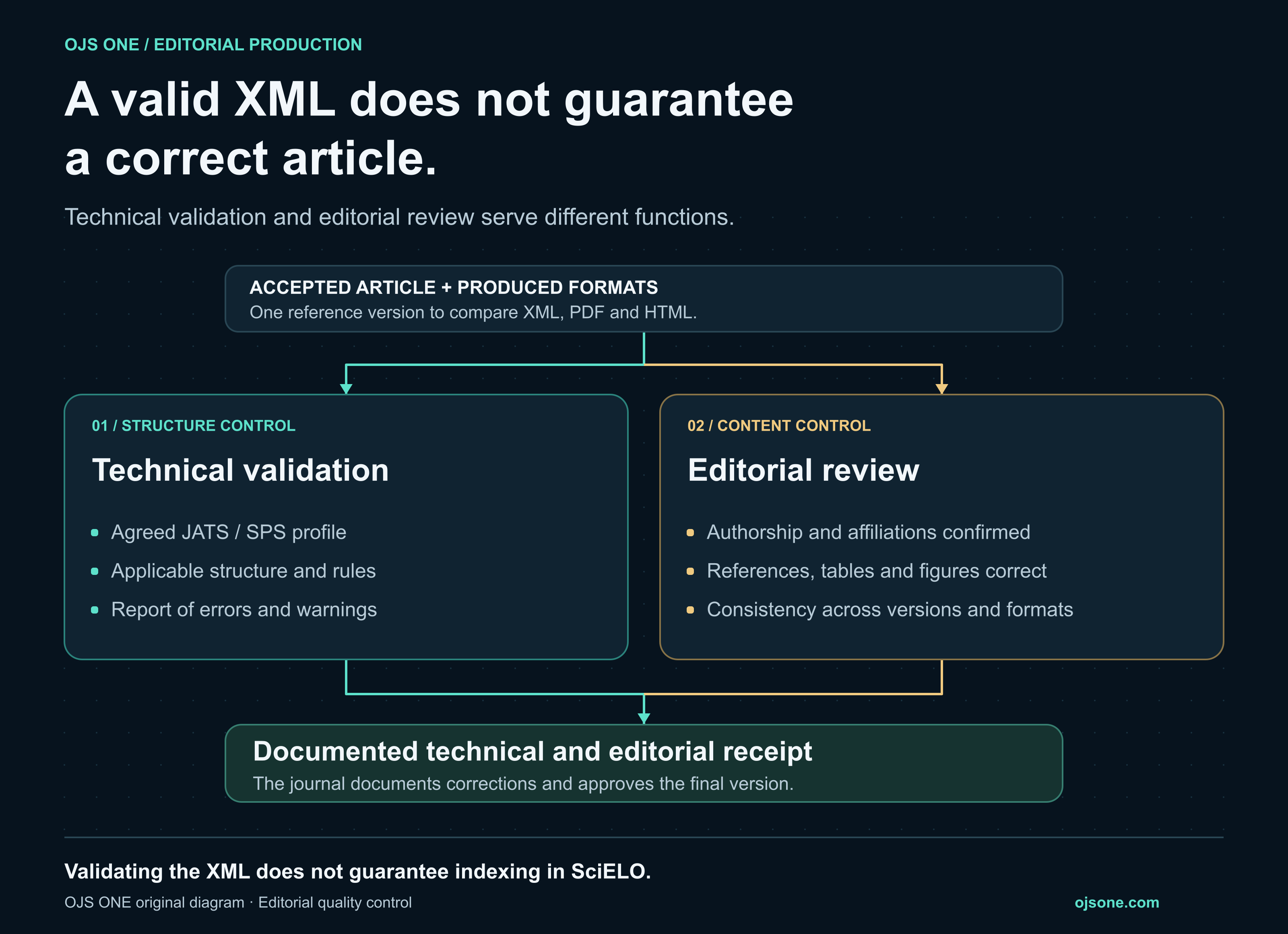
Technical validation and editorial review are distinct controls: both are necessary to accept a documented delivery.
Use the same sample and the same scope to evaluate the alternatives. Ask each participant to record what they received, what queries they needed to make and which part your team resolved. That way you can tell the work that is included from the work that ends up coming back to the institution.
The test should leave this evidence:
- An output package with the agreed files and an identification of its version.
- A technical report indicating the controls applied and pending observations.
- The editorial queries resolved, with the person who authorized each decision.
- A correction requested by your team and its propagation to the affected outputs.
- The HTML and PDF opening in the environment where you plan to offer them.
SciELO documents error reports, warnings and package validations in Package Maker.[5] You can take those records as a reference when asking for technical evidence, without requiring a single tool from those who take part.
To review the content of the sample, use our guide on errors and editorial control in JATS XML for SciELO. Here the goal is different: to check who detects a problem, who resolves it and what evidence they deliver before closing.
Agree on owners, QA and editorial version control
Assign one responsible person for each transition, even if you hire the whole production. We recommend attaching a short matrix like this one to the proposal and completing it with names or roles.
| Activity | Owner you should identify | Suggested closing evidence |
|---|---|---|
| Authorize the content for production | The journal's editorial counterpart | Approved version and authorization date |
| Produce and validate | Institutional operator or provider | Identified package and control report |
| Resolve content queries | Designated editor | Recorded answer, with no inferred changes |
| Review and accept the delivery | The journal's counterpart | Approval or pending observations |
| Upload files and maintain reading | IT, administrator or contracted provider | Access test and support owner |
Define quality control, or QA, as an assigned task. The contract should say who reviews the producer's output, who interprets warnings and who can authorize a documented exception. Avoid each participant assuming that someone else did that review.
For corrections, distinguish a production defect with respect to the authorized version from an editorial change requested later. We recommend agreeing on how each case is recorded, what the contract covers and when the scope should be reviewed. Do not accept a vague formula of included corrections without knowing how they are processed.
Also test editorial version control. In a hypothetical case, the journal changes a caption after receiving the proofs. The owner records the request, identifies the affected outputs and delivers the replacement with its approval. Ask for that path to be demonstrated during the sample, including how the previous delivery is withdrawn from operational use.
Evaluate total cost, access and continuity
Compare the work the institution will have to sustain throughout the relationship. We recommend reviewing internal time commitments and quoted items, without turning them into a supposed saving or an invented return on investment.
With an in-house team, consider training, replacements, technical support and template maintenance. With an external tool, ask about access, export and operator assistance. With a full service, confirm whether coordination, corrections and reading outputs are part of the scope. Request quotes with these items separated so you can discuss them.
Access to the files deserves its own clause. Ask for a specification of what you will receive of the XML, the images, the HTML and the PDF; where the institutional copies will be kept; and what documentation will allow you to resume the work. Do not assume that delivery of the provider's software is included: distinguish your editorial files from components subject to a license.
For the HTML viewer or PDF generation, identify who maintains the templates, who checks compatibility with OJS and what support continues when the contract ends. Ask whether you will be able to keep reading the articles without an active producer account, and require an answer that applies to the offered model.
Continuity of knowledge is also contracted or organized. Keep tagging decisions, the journal's particular criteria and resolved queries in an accessible record. If the operator or provider changes, that record must accompany the files. It is best to test the final handover before ending the relationship, not to discover it when you already need to change owner.
Avoid common mistakes when comparing proposals
Discard comparisons that hide pending work. These are criteria we recommend using when reviewing an offer:
- Buying a tool as if it included an operator. Ask who tags, corrects and answers queries.
- Evaluating only a simple article. Include the difficulties that appear in your usual calendar.
- Assuming publication in OJS is included. Separate delivery, upload and maintenance of the viewer.
- Accepting files without a correction mechanism. Request an owner and a replacement log.
- Delegating without keeping copies or documentation. Check that you can recover the package and its editorial decisions.
- Choosing because of a promise of acceptance. Do not accept a guarantee of entry into SciELO as a production deliverable.
The decision can be mixed: for example, as a hypothetical work design, a portal keeps institutional coordination and hires production for part of its calendar. Evaluate that option with the same criteria and make clear who answers for each article.
Frequently asked questions
Does outsourcing make sense if I publish few articles?
It may suit you if you do not have a person with assigned time and a backup to produce them. We recommend deciding with a sample and a documented estimate of institutional work, not with a universal threshold of articles. A small volume does not remove the coordination and approval tasks either.
Can I use a tool and hire help only for complex cases?
You can propose that option to the provider, but confirm that they offer it and define the cases they will receive. Agree on who reviews the whole, how projects are transferred and who resolves a correction that affects files produced by different teams.
What should I keep if I change provider?
We recommend keeping the agreed editorial package, the control reports, the correction history and the journal's decisions. Also check the rights and terms of use of templates or viewers. Do not assume that receiving files means receiving the software that generated them.
Evaluate a JATS XML tagging service with a clear scope
Choose the model you can supervise and sustain. The sample should show you both the quality of the delivery and the work your institution will keep; the agreement should leave corrections, access and continuity resolved.
Jatson describes the production of JATS XML, editorial PDF and HTML from accepted articles.[6] That capability corresponds to production, not to peer review. If you are evaluating delegating it, request a production evaluation with Jatson and indicate your target, calendar and representative sample. Define the scope before committing to a delivery.
Sources
- JATS Studio: usage modes and tagging service — accessed 2026-10-22.
- SciELO MarkAPI: the project's official repository — accessed 2026-10-22.
- National Library of Medicine: Journal Article Tag Suite — accessed 2026-10-22.
- SciELO Style Checker — accessed 2026-10-22.
- SciELO documentation: How to validate the SPS XML package — accessed 2026-10-22.
- OJS ONE Jatson: editorial production — accessed 2026-10-22.
Is your journal struggling with slow performance or recurrent outages?
Contact our team and see how enterprise-grade infrastructure can transform your editorial operation.
Request assessment