
JATS XML for SciELO: Errors a Valid XML Can Still Contain
Review authorship, reference and version errors that a valid JATS XML can still contain. An editorial control guide for journals publishing in SciELO.
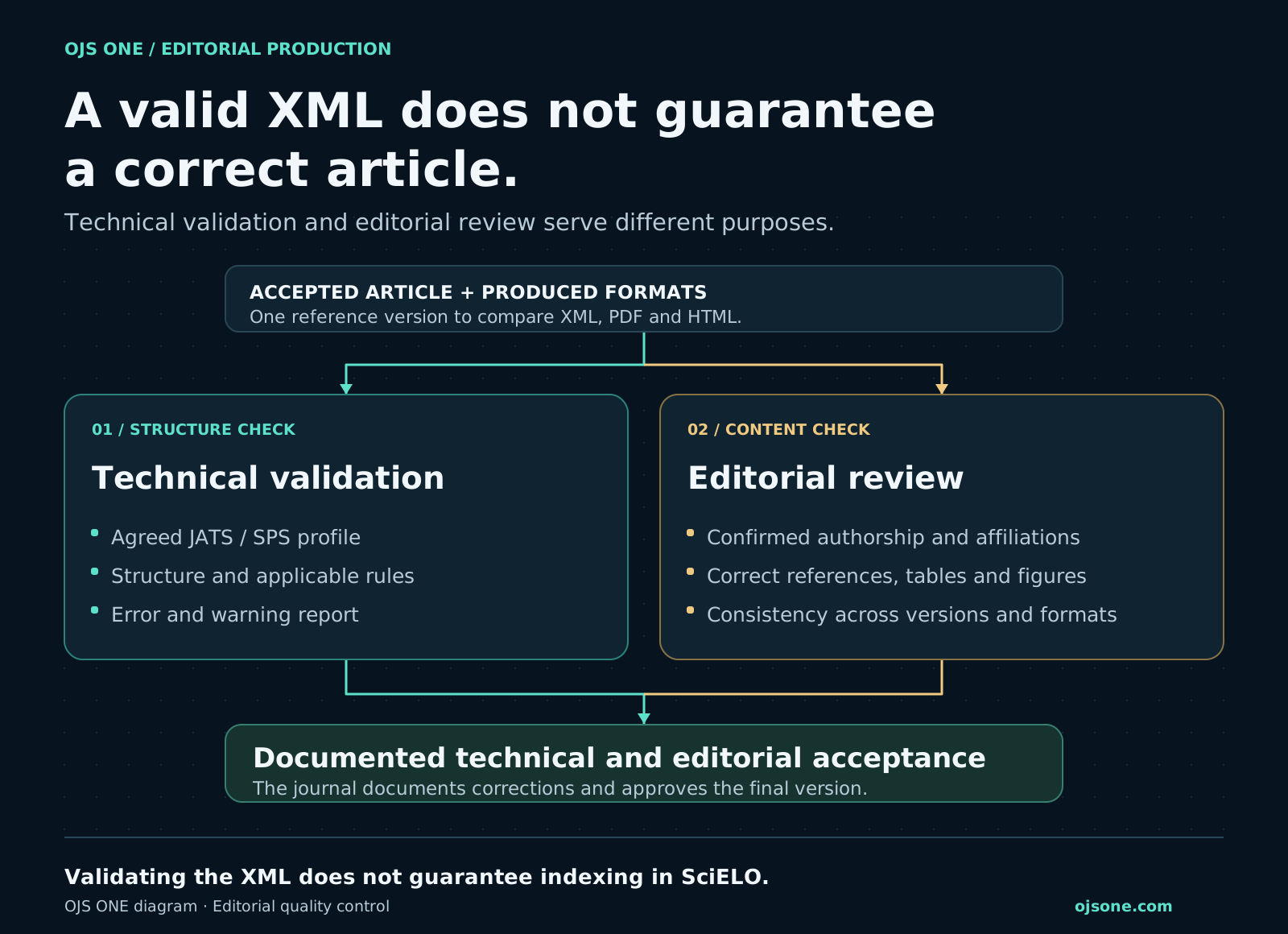
Receiving an XML with no validation errors is an important technical result. Even so, the journal needs to confirm that the file represents the article it approved: the same authors, affiliations, results, tables and references.
A piece of data can be correctly tagged and still be wrong. An author's surname may have one letter changed; a figure may belong to an earlier revision. The structure can be valid while the content still needs an editorial correction.
For a journal that commissions JATS XML tagging for SciELO, it is worth distinguishing technical validation from approval of the content. Both are part of accepting the work, but they answer different questions.
What validation checks and what the journal must check
The SciELO Style Checker verifies conformity with the style defined in the SciELO Publishing Schema guidelines. For its part, the XML Package Maker documentation describes checks on documents and packages, including data shared between articles, identifiers, and reports of errors and warnings.[12][13]
These checks are useful for finding rule violations and certain inconsistencies. They are not an independent verification of every scientific claim or of the identity of every person mentioned in a manuscript.
Our recommendation is to split acceptance into two records:
- Technical check: the agreed profile, the tools used, the validation results and any outstanding observations.
- Editorial check: correspondence with the accepted version, integrity of the content and approval of the reading outputs.
A favorable technical report should not automatically close the second record.
Authors and affiliations: well-formed data can still be wrong
Compare names and surnames with the final document and with the metadata confirmed by the journal. Review the author order and the relationship between each person and their affiliations. If identifiers are present, check that they belong to the person they are declared for.
It is not enough for an ORCID iD to have a recognizable format. The editorial problem may be that it belongs to someone else. Nor is it appropriate to infer an institutional affiliation from an email address or to fill in an identifier because names look similar.
When the source is ambiguous, record the query and return it to the editorial owner. An explicit pending correction is better than data added without confirmation.
Frequently asked questions
Does a valid JATS XML guarantee the article is correct?
No. Validation checks structure and rules, not whether authors, affiliations, references, tables and figures match the approved article. That is why it is worth separating a technical check from an editorial check.
What errors can a valid JATS XML still contain?
Surnames with one letter changed, ORCID iDs that belong to someone else, references that mix data from different works, figures from an earlier revision, or differences between the XML, the PDF and the HTML.
Does passing validation guarantee indexing in SciELO?
No. Tagging organizes content for a publishing workflow; admission to or continued inclusion in SciELO is decided by its evaluation bodies and is not obtained by passing a validator.
References: a matching structure is not a matching work
A reference can contain an author, title, year and DOI and still mix data from different publications. We recommend checking doubtful references against the cited work or a reliable bibliographic source, without inventing missing identifiers.
The check should also cross-reference in-text citations with the reference list. It is worth looking for citations without a matching entry, entries that are never cited when the editorial policy requires it, duplicate references, and changes introduced during copyediting.
Not all of these findings point to misconduct. They may result from misaligned versions or production errors. The journal should resolve the case with evidence before attributing a cause.
Tables, figures and equations: review what the reader receives
Check that each figure and table reference in the text points to the right object and that the associated file corresponds to the approved version. Review titles, units, notes, symbols and permissions where relevant.
In a table, a missing figure or a note placed in the wrong column can change the interpretation. In an equation, an omitted symbol can go unnoticed when only the overall appearance of the article is reviewed.
The Package Maker documentation includes package review and data views such as languages, dates, affiliations and references. That evidence helps guide the review; it does not remove the need to compare against the approved content.[13]
An example of inconsistency between versions
Hypothetical case: during the final correction, the journal replaces figure 2 and changes its caption. The PDF incorporates the change, but the XML is produced from the earlier Word file. The HTML derived from that XML keeps the old figure.
The problem is not solved by approving each file separately. It requires identifying the reference editorial version, correcting the structure or the associated files, and reviewing the affected outputs again.
To avoid this, we recommend that the journal keep a single approved production version and a short change log. A late change should state what changed, who authorized it and which formats need regeneration or review.
Checklist before approving the package
Editorial acceptance can rely on these questions:
- Does the package correspond to the final version the journal authorized?
- Are the authors, affiliations and correspondence details confirmed?
- Do the citations, references and bibliographic links point to the right works?
- Do tables, figures and equations keep their content and cross-references?
- Do titles, abstracts, dates and bibliographic data match across the relevant outputs?
- Does each technical error or warning have a resolution or a documented justification?
- Did the journal review the PDF and the HTML, in addition to the XML file?
- Is there an identified person responsible for approving the delivery and requesting corrections?
This is an editorial quality-control proposal. It should be adjusted to the technical profile, the article and the procedures of the relevant collection; it does not replace their instructions.
Approve production without confusing it with indexing
Tagging organizes content for a publishing workflow. The decision on admission to or continued inclusion in SciELO rests with its evaluation bodies and is not obtained by passing a validator.
The Jatson page describes the coordinated production of JATS XML, PDF and HTML from the accepted article.[1] To make use of that workflow, the journal must keep responsibility for the inputs and for editorial approval.
If you need JATS XML tagging for SciELO, contact OJS ONE with the number of articles, the destination and the status of the final files. The scope of production and quality control is defined before committing to a delivery date.
References
Is your journal struggling with slow performance or recurrent outages?
Contact our team and see how enterprise-grade infrastructure can transform your editorial operation.
Request assessment