
OJS Training: A Practical Program for Editors and Managers
Evaluate OJS training by its exercises, roles and learning evidence. Define a practical program for journal editors and managers.
An OJS training should let each participant complete the tasks of their role and recognize when they need help. We recommend evaluating the program by its exercises and learning evidence, not only by its syllabus. Watching a demonstration can guide, but carrying out a simulated submission and explaining a decision shows what was learned.
OJS covers the journal website and the submission, review, editing and publication process.[8] To prepare useful training, it is worth choosing which part of that path each person needs to practice, instead of teaching every screen to everyone.
Diagnose the installation and the real tasks
We recommend starting with the installed version, the participants' roles and the difficulties they need to resolve. It is also worth recording the working languages, particular configurations and the functions that will be part of the exercises.
PKP's learning documentation for OJS 3.5 separates content for site administrators, journal managers, the editorial workflow, authors and reviewers.[8] We recommend using the documentation that matches the course installation, without assuming that an explanation for another version will be identical.
The diagnosis can collect concrete situations: one person needs to assign reviewers; another must correct metadata before publishing. Those tasks help define the program. It is also worth agreeing on what stays out, such as a server upgrade or the specialized production of article files.
Distinguish the journal manager from the technical administrator
OJS uses roles with different access and responsibilities: the journal manager accesses the workflow and the settings, while other participants have narrower permissions.[7] We recommend that this difference appear in the objectives and in the practice accounts.
The site administrator takes care of the installation and of the journals within it.[7] PKP also notes that running the web service requires a competent system administrator.[8] It is worth distinguishing both responsibilities when contracting training, even if an institution may assign them to the same person.
We do not recommend including Linux maintenance as required learning for all editors. Server technical training needs its own audience and scope. For journal managers, it is worth prioritizing authorized configuration, permissions, workflow coordination and criteria for escalating problems.
Link each objective to evidence
We recommend writing objectives that can be observed. "Know the review process" is too broad to evaluate; "assign a simulated review and check its status" describes a concrete task.
For each objective, it is worth agreeing on an activity, an expected result and a way to review it. The evidence can be a record of the exercise or an explanation from the participant about the action taken. We do not recommend confusing attendance with command of the workflow.
It is also worth reserving a recovery activity: if a person makes a mistake, they should be able to identify the problem and fix it. The purpose of practice is to check that they can work with judgment, not that they remember a sequence of clicks during the demonstration.
Sample program: practice the complete path
The following program is an adaptable editorial recommendation, not a contractual offer. Its length should be defined after the diagnosis, according to participants, objectives and practice opportunities.
Prepare a rehearsal environment
We recommend using fictitious accounts, manuscripts and reviews, labeled as training material. It is worth controlling who accesses the environment and preventing a practice session from publishing content or sending messages to people outside the exercise. We do not recommend reusing confidential manuscripts to make the course more "realistic".
Receive and handle a submission
The first activity can be a fictitious submission: reviewing its files, checking its metadata and detecting incomplete information. Afterwards, we recommend that the person in the editorial role explain what needs to be corrected and who must do it.
In the review practice, it is worth simulating the assignment of a review, its receipt and an exercise editorial decision. The journal must define the scientific criteria; the training teaches how to represent the agreed procedure and document its actions, without replacing that judgment.
Prepare the publication and review its quality
We recommend continuing with a sample accepted only for the exercise. Participants can review authorship, titles, abstracts, files and the planned publication data. It is worth checking the result from the reader's perspective, within the rehearsal environment.
The quality-control activity can introduce a deliberate error in the fictitious data, such as a title that does not match the file. The participant must detect it, explain who corrects it and repeat the check. That evidence allows responsibilities to be discussed before working with real content.
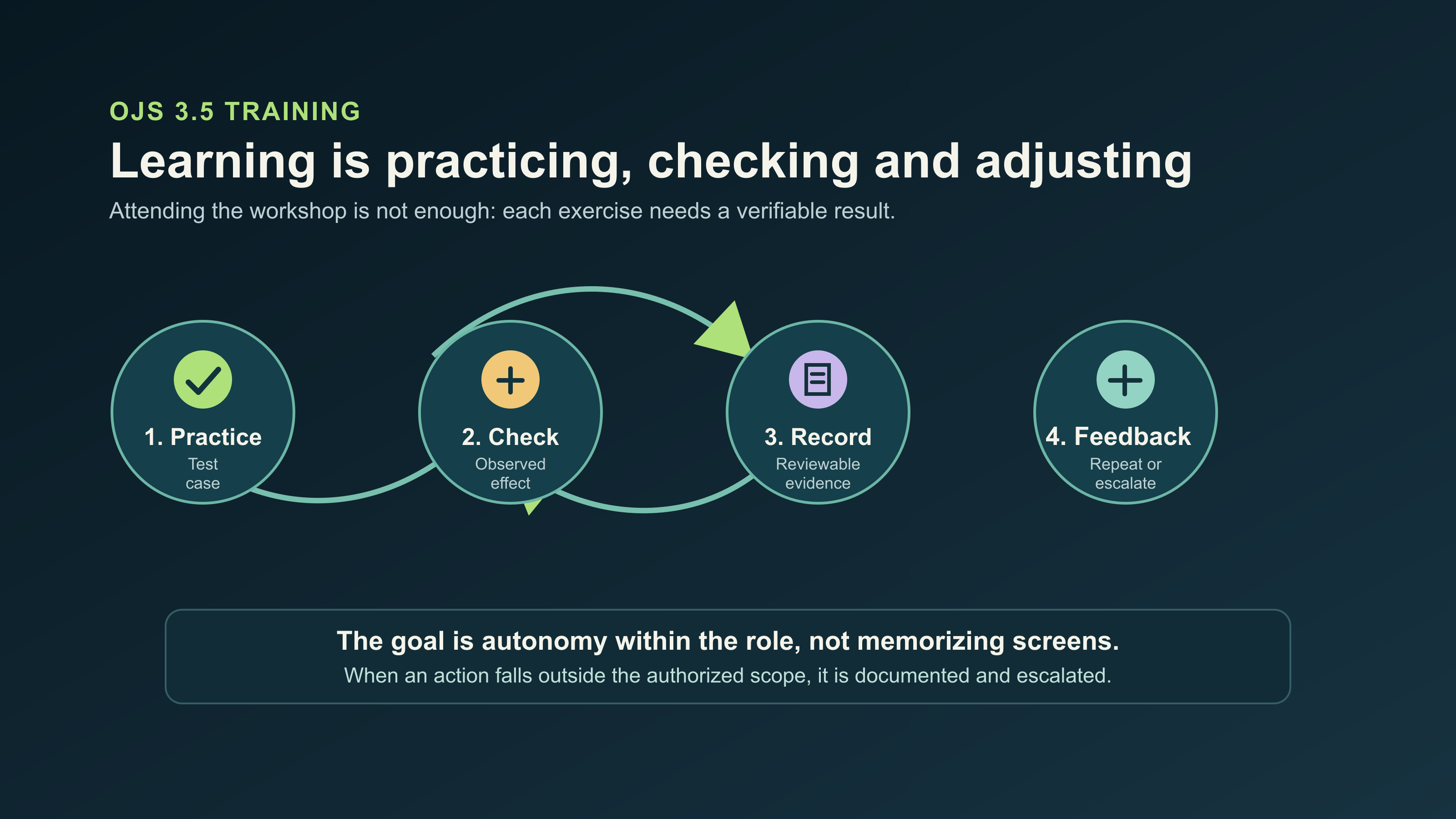
The cycle turns each activity into evidence of autonomy within the authorized role.
Evaluate autonomy and know when to escalate to support
We recommend closing with a task that the participant solves without following the demonstration step by step. The review should indicate what they completed, where they needed help and what they should practice again.
As an escalation criterion, it is worth separating a procedural question from a possible technical incident. If an account cannot perform an expected task, we recommend recording the role, the action attempted and the message observed, without sharing passwords or confidential documents. The designated person can then determine whether to review permissions or request technical support.
Hypothetical example: an editor completes the rehearsal submission but does not receive the expected notification. The evaluation can recognize that they led the exercise and documented the problem correctly for support. It would not be reasonable to expect them to repair the mail server. This example does not correspond to a real client.
Checklist for choosing the program and its provider
It is worth asking for a proposal that lets you answer these questions before contracting:
- Does the diagnosis identify the version, roles and tasks that need practice?
- Does each objective have an exercise and a piece of learning evidence?
- Does the program distinguish editorial management, site administration and server?
- Do the practices use fictitious data without confidential manuscripts?
- Is there quality control before any rehearsal publication?
- Does the evaluation include error correction and additional practice?
- Will materials suited to the version and the agreed scope be delivered?
- Is it clear how to ask questions and when to escalate an incident?
To place the training within a broader project, you can review the OJS ONE OJS services, whose page describes implementation, operation and technical support.[11] If you need to define a program by roles, contact OJS ONE with the version, participants and tasks they expect to carry out. We recommend agreeing on exercises, evaluation and the limits of the service in the proposal, without assuming technical maintenance is included.
Frequently asked questions
What should OJS training for editors and managers include?
A diagnosis of the installed version, roles and real tasks; observable objectives, each with an exercise and a piece of learning evidence; practice in a rehearsal environment with fictitious data; and an assessment of autonomy that says when to escalate to support.
What is the difference between a journal manager and a site administrator in OJS?
The journal manager accesses the editorial workflow and the settings of their journal; the site administrator takes care of the installation and of the journals within it. PKP also notes that running OJS as a web service requires a competent system administrator.
How do you evaluate whether OJS training worked?
With a final task that the person solves without following the demonstration step by step, and a record of what they completed, where they needed help and what they should practice again. Attending the course does not show command of the workflow.
References
Is your journal struggling with slow performance or recurrent outages?
Contact our team and see how enterprise-grade infrastructure can transform your editorial operation.
Request assessment