
The complete guide to AI search in OJS
What to evaluate before enabling AI search in OJS: a bounded corpus, verifiable citations, operations, privacy and the questions your journal must answer.
The complete guide to AI search in OJS
AI search in OJS can help a reader ask questions about a journal's published archive. To be useful in an academic setting, it must show which articles an answer comes from, stay within the authorized corpus and make clear what it cannot answer.
This is not about placing a generic chat next to a journal. It is about designing a retrieval and query layer that respects editorial boundaries.
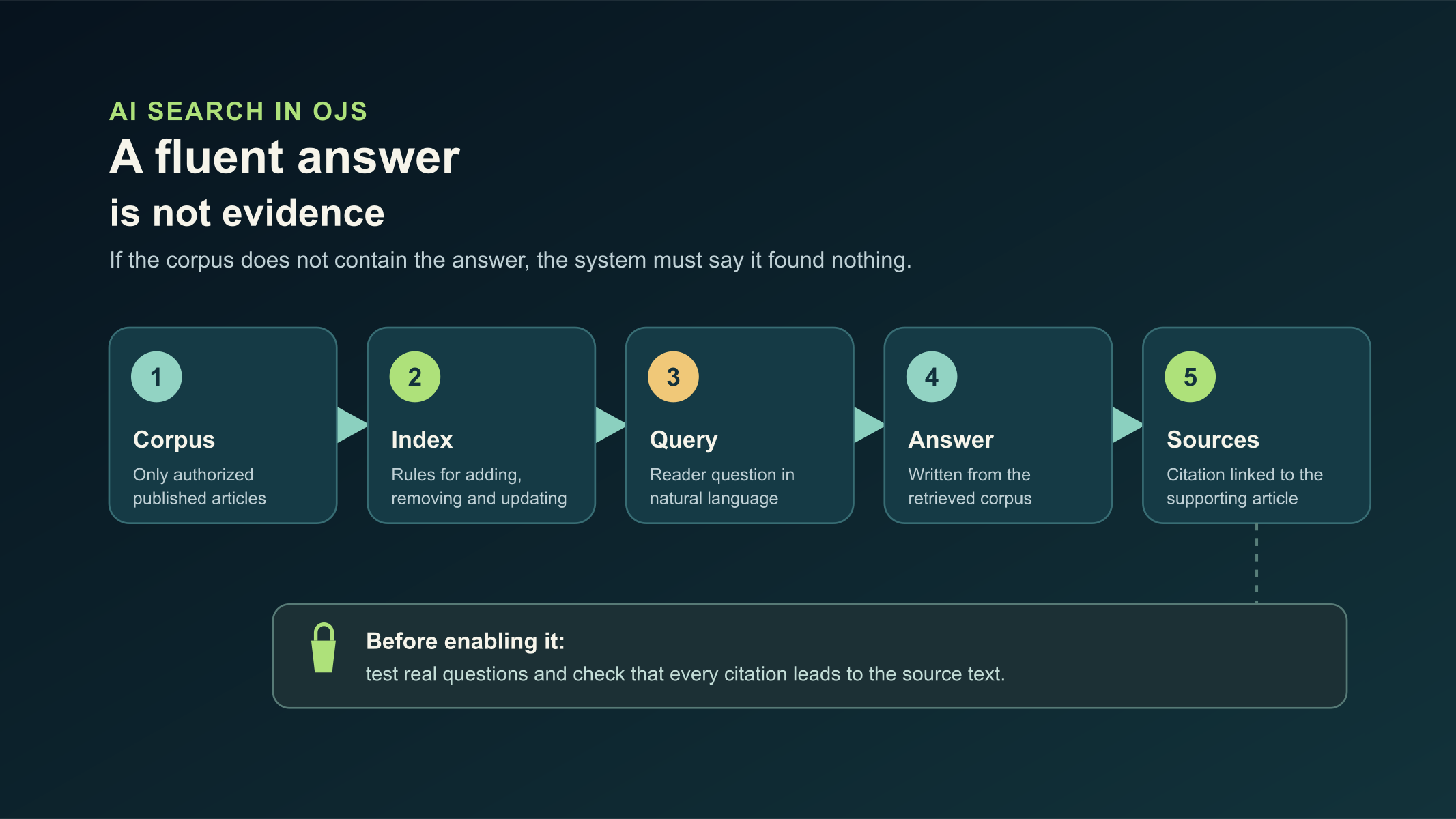
Original diagram. An AI answer is only useful to a journal if every claim can be traced to a published article.
What problem AI search can solve
Traditional search returns results by words and filters. An AI layer can interpret a natural-language question and retrieve relevant passages before drafting an answer. That approach helps when readers do not know the exact terms authors used or need to connect results spread across several articles.
But a fluent answer is not evidence in itself. The implementation must let readers reach the articles that support each claim.
The core requirement: a bounded corpus and traceability
Before evaluating a tool, define which documents it may consult: published articles, full issues, supplements, preprints or editorial material. Do not mix published content with manuscripts under review, internal communications or user information.
The Lumen page states that it operates on the articles the journal has published, without accessing external sources, and that its answers link direct citations to published articles.[1] That is a capability declared by OJS ONE, and it should be checked in a demonstration with real questions and citations before adding it to a portal.
Traceability should include, at a minimum, the article title, authorship, year, volume or issue and a link to the text. If an answer cannot show its sources, treat it as an exploration interface, not as an academic reference.
How a RAG layer works in operational terms
RAG stands for retrieval-augmented generation. The process can be described like this:
- authorized documents are indexed;
- the reader asks a question;
- the system retrieves potentially relevant passages;
- a model drafts an answer using that context;
- the interface provides links or citations for verification.
PKP's documentation describes a plugin as a component that extends OJS's base functionality and can add fields, change templates or save new information.[2] That does not prove that every installation has semantic search or that an integration is automatic. Each implementation must review the OJS version, how content is indexed, permissions and where answers are displayed.
Questions to ask before enabling it
What content enters the index?
Require a list of sources and a process to exclude retracted articles, replaced versions or content that must not appear. Define when the index updates after a publication and how a wrong metadata value is corrected.
How are sources shown?
Test with factual and controversial questions. The answer must link to the article that actually supports it, not just to a general page of the journal.
What data reaches external providers?
Clarify whether the reader's query, the retrieved passages or the metadata leave the institutional infrastructure. Review contracts, retention, access controls and data handling. Do not feed an AI layer with manuscripts under evaluation unless there is authorization and a specific design for it.
What happens when there is not enough evidence?
The system must be able to say it found nothing in the corpus instead of filling in an answer with general knowledge. That behavior is as important as the quality of a positive answer.
Integration with the editorial workflow
AI search starts after publication, not during evaluation. Before indexing, the journal needs stable content, consistent metadata and links that last. That is why the decision connects with earlier production and publishing work, without replacing it.
In an OJS portal it helps to separate responsibilities: the editorial team decides what is published and indexed; whoever operates the platform reviews availability, updates and permissions; whoever delivers the tool documents its sources, limits and support. OJS administration: tasks and evidence for journal portals offers a useful framework for that assignment.
Common mistakes
The first mistake is announcing that AI "eliminates hallucinations". No interface should make that promise. A bounded corpus and visible citations reduce the risk and make verification easier, but they do not replace reading the source article.
The second is measuring success by the number of questions. A useful query should lead to verifiable evidence and respect the journal's scope.
The third is using the same configuration for a research journal and for a full portal without defining limits per publication. The index and the interface must respect the editorial organization of the site.
Frequently asked questions
Does AI search replace OJS's own search?
Not necessarily. It can complement the existing keyword search and navigation for natural-language questions.
Can it answer from the whole internet?
That depends on the design. For a journal, it helps to clearly distinguish a tool limited to the published corpus from a general web assistant.
Is it useful for reviewing manuscripts?
It should not be assumed. This guide covers querying already published content; manuscripts and peer review require different confidentiality controls.
Conclusion
AI search in OJS makes sense when it improves access to the archive without hiding the sources. Prioritize a bounded corpus, verifiable citations, update rules and clear limits.
OJS One Lumen is the academic intelligence layer declared by OJS ONE for querying published articles with answers traceable to their source. Before enabling it, request an evaluation of your journal's corpus and operating conditions.
Sources
- OJS ONE, OJS One Lumen: Academic Intelligence Layer for OJS — accessed 2026-10-26.
- PKP, OJS/OMP/OPS Plugin Guide and Inventory — accessed 2026-10-26.
Is your journal struggling with slow performance or recurrent outages?
Contact our team and see how enterprise-grade infrastructure can transform your editorial operation.
Request assessment