
Best software for multi-journal academic portals
How to compare software for a multi-journal portal: per-title separation, shared governance, workflow, data and operations, with OJS, Janeway and Scholastica.
Best software for multi-journal academic portals
The best software for a multi-journal portal is not chosen by the number of features in a demo. It is chosen by its ability to separate the identity and workflow of each journal while the institution keeps shared governance, security, updates and operational evidence.
A university that manages several titles must compare a platform, its operating model and the services that complete production. Confusing those three layers produces contracts that are hard to govern.
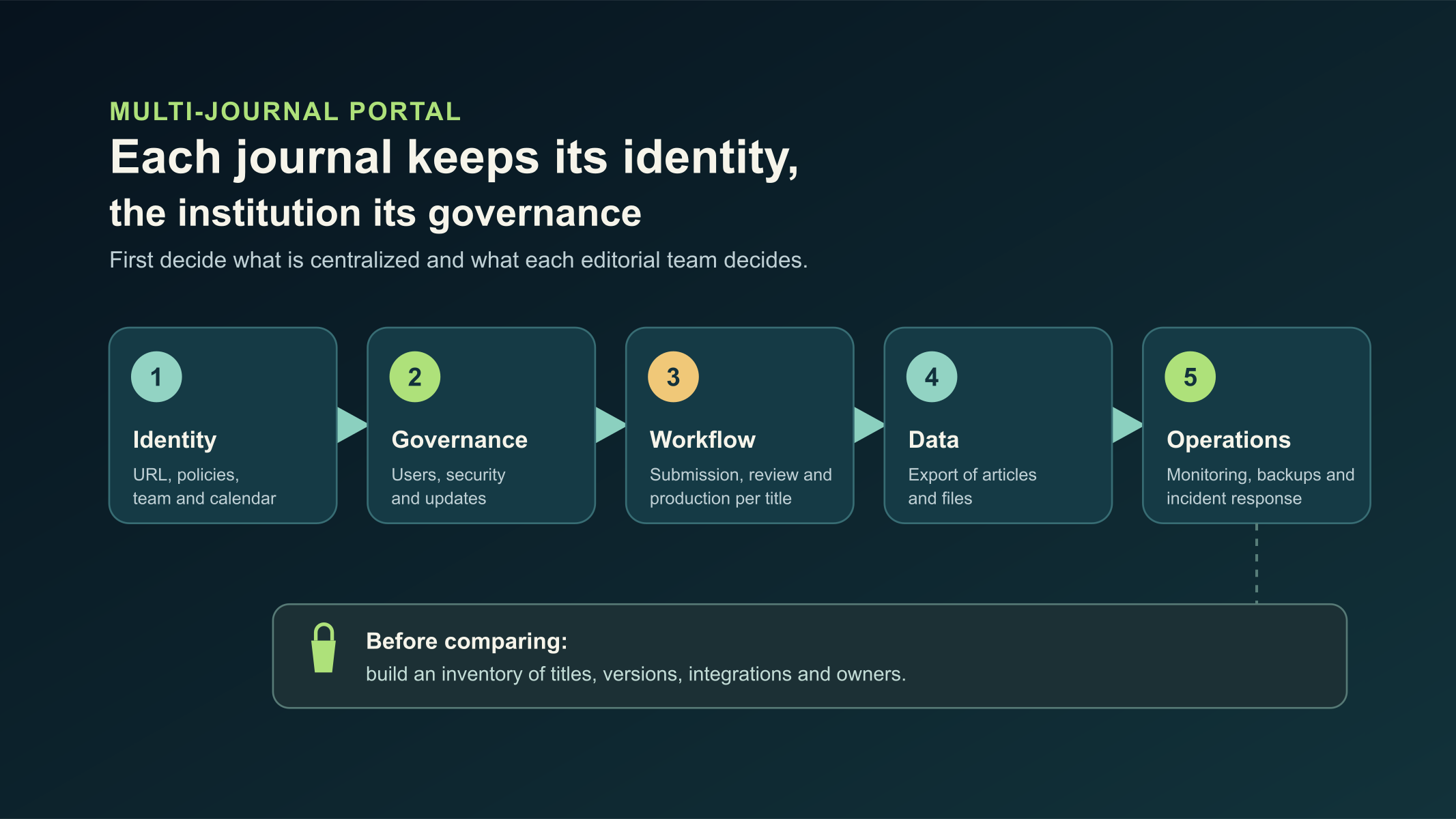
Original diagram. In a multi-journal portal each journal keeps its identity and the institution defines the shared governance.
Start with the institutional problem, not a feature list
A multi-journal portal has two needs that must coexist: each journal keeps its own policies, teams, URL and calendar; the institution needs cross-cutting rules for identities, backups, updates, email, metadata and support. OJS documentation covers a site with several hosted journals and site-level settings when there are two or more.[1]
That is why the first question is not "which platform has more buttons?". It is: which decisions stay centralized and which must editorial teams be able to make?
OJS: suitable when you need a governable editorial portal
OJS is an open-source platform for managing and publishing academic journals. PKP's documentation describes creating and managing hosted journals from site administration, and it distinguishes shared settings from those specific to each journal.[1]
For an institutional portal, that architecture lets you evaluate four elements clearly:
- controlled creation and removal of journals;
- identities and roles with traceability;
- update policies and plugin compatibility;
- monitoring, backup and restoration of the whole, not just one title.
The platform does not solve operations on its own. An institution must assign owners for incidents, version changes, domain renewals, email delivery and metadata review. OJS administration: tasks and evidence for journal portals can serve as a complement to define that matrix.
Janeway: an open-source alternative worth reviewing for its technical fit
Janeway presents itself as an open-source academic publishing platform. It declares features for submissions, open, anonymous and triple-anonymous review, copyediting, typesetting, roles, JATS XML, PDF, HTML and preservation.[2]
That is not enough to conclude it is interchangeable with OJS. The right comparison must include local technical capacity: Janeway's own hosting page lists requirements for self-hosting a Django application, PostgreSQL and domains.[3] For an institution, that dependency is an operations question: is there capacity to maintain that architecture and respond to an update or incident?
Scholastica: a service alternative that requires comparing scope and dependency
Scholastica declares a commercial platform that brings together peer review, publishing and typesetting services, with HTML, PDF and JATS XML deliverables for its OA Publishing clients.[4] It also states that it does not offer bespoke development.[4]
That model can be suitable if a journal accepts a standardized product. For a university portal, the evaluation must review how several journals are managed, what data can be exported, what institutional integrations are needed and which controls remain outside the platform. It is not a question of "best" in the abstract: it is a fit between the way of operating and the level of control required.
The matrix that avoids a wrong purchase
Before selecting software for multi-journal portals, score each alternative with your own evidence from a test or current documentation:
| Criterion | What to check |
|---|---|
| Per-journal separation | Independent URL, configuration, roles, themes, policies and files |
| Shared governance | users, security, updates, email, backups and audit |
| Editorial workflow | submission, review, editing, production and publication with real roles |
| Interoperability | DOI, ORCID, OAI-PMH, metadata, XML and preservation according to each title's needs |
| Data and exit | documented export of articles, users, metadata and files |
| Operations | who monitors, updates, tests restores and responds to incidents |
| Production | how PDF, HTML and JATS XML are coordinated from the accepted article |
The test must use concrete scenarios: create a non-public journal, assign test roles, process a sample manuscript, review an export and simulate a restore in a separate environment. Do not accept a demonstration without evidence of those points.
Common mistakes when comparing multi-journal platforms
The first is comparing only licenses. The institutional cost includes operations and the coordination work left between IT, editorial teams and providers.
The second is assuming JATS XML or HTML come solved because a platform mentions them. Ask for the output profile, the review of references, the handling of figures and who approves the editorial version.
The third is using the same configuration for journals with different risks and volumes. A portal requires common standards, but editorial policies must not end up homogenized by accident.
Frequently asked questions
Can a single installation host several journals?
Yes. OJS documents the management of hosted journals and site settings for installations with two or more journals.[1] The additional decision is how infrastructure and roles will be governed.
Does a multi-journal portal remove the need for support?
No. It centralizes tasks, but it does not replace update testing, backup, email and attention to editorial teams.
Which platform is best for a university?
The one that demonstrates fit with its workflows, responsibilities, interoperability requirements and operating capacity. The name of the platform does not replace that verification.
Decision and next step
For a portal with several journals, start with an inventory of titles, versions, integrations, owners and risks. Then compare alternatives with a documented test, not a commercial list.
OJS ONE offers specialized OJS operations and an institutional proposal to centralize infrastructure, support and editorial production when that model fits the university's scope. The evaluation must first define which responsibilities the institution wants to keep.
Sources
- PKP, Learning OJS: Site Administration — accessed 2026-10-26.
- Janeway, Janeway — accessed 2026-10-26.
- Janeway, Hosting — accessed 2026-10-26.
- Scholastica, Publisher Guide — accessed 2026-10-26.
Is your journal struggling with slow performance or recurrent outages?
Contact our team and see how enterprise-grade infrastructure can transform your editorial operation.
Request assessment